
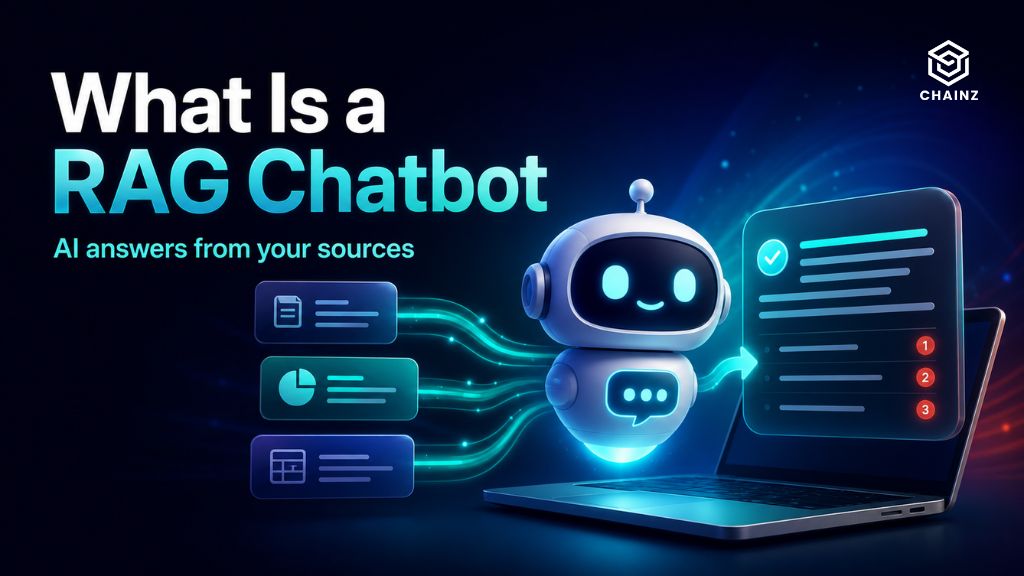
A RAG chatbot is an AI assistant that answers from your information – your documents, policies, and data – instead of relying only on what a language model happened to learn during training. RAG stands for Retrieval-Augmented Generation, and the idea is simple: before the AI answers, it retrieves the relevant facts from your knowledge base and generates its reply based on those facts. The result is an assistant that’s accurate about your business, not just fluent in general.
If you’ve ever seen an AI confidently invent an answer, you’ve seen the problem RAG solves. This guide explains what a RAG chatbot is in plain terms, how it stops those made-up answers, how it compares to the alternatives, and when your business actually needs one.
The Problem RAG Solves: Confident, Wrong Answers
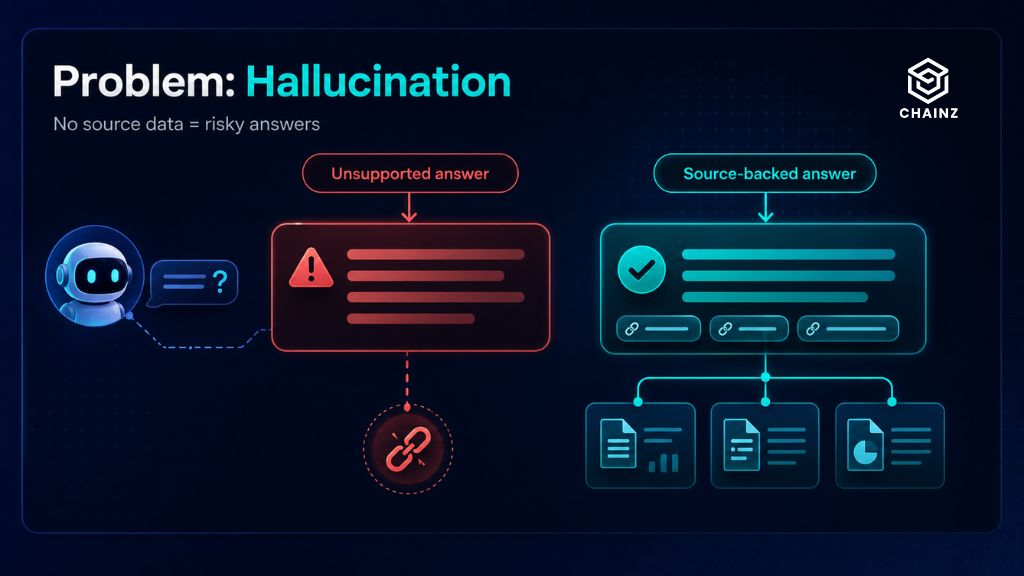
A standard language model like GPT-4o or Claude is trained on a vast but fixed set of general information. Ask it about your specific refund policy, your product catalogue, or your internal procedures, and it has two options: admit it doesn’t know, or — more often – guess convincingly. That confident guessing is called a hallucination, and for a business it’s dangerous. An AI that tells a customer the wrong return policy or quotes a price that doesn’t exist creates real problems.
The root cause is simple: the model was never given your information. It’s answering from general knowledge because that’s all it has. A RAG chatbot fixes this at the source.
How a RAG Chatbot Actually Works
The mechanism sounds technical but the logic is intuitive. Here’s what happens each time someone asks a question:
- You ask a question. “What’s your refund policy for damaged items?”
- Retrieval. The system searches your connected knowledge base – your documents, policies, help articles – and finds the passages most relevant to the question.
- Augmentation. Those retrieved passages are handed to the language model along with the question, as context.
- Generation. The model writes its answer based on the facts you provided – not on general training data.
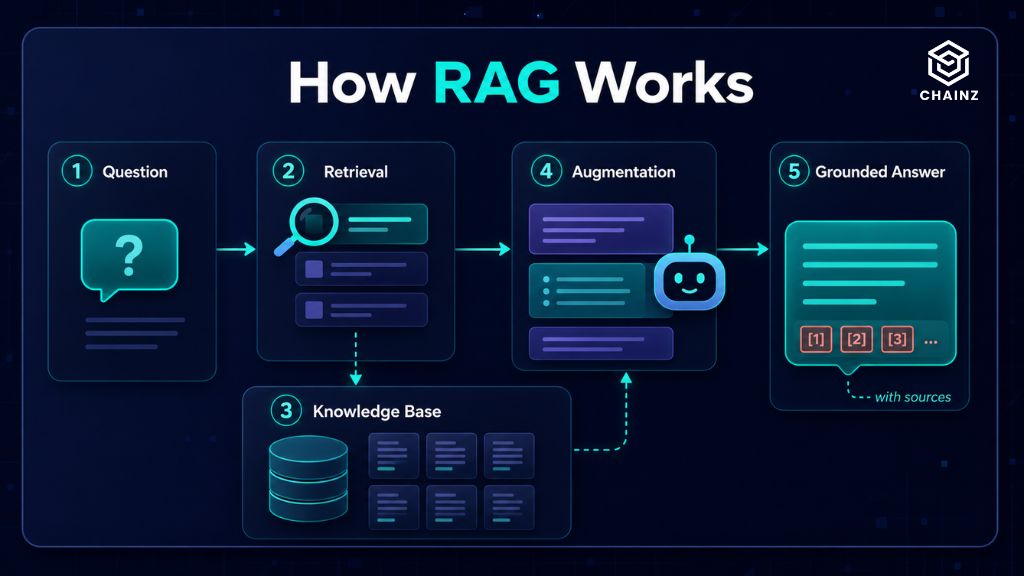
The difference is the retrieval step. Instead of asking the AI “what do you know?”, a RAG chatbot asks “here are the facts – now answer using these.” That’s why a well-built one can even cite its source, showing which document an answer came from. Trust goes up; hallucinations go down.
RAG vs Fine-Tuning: Which Does Your Business Need?
When people want an AI to “know” their business, they usually reach for one of two approaches. They solve different problems, and confusing them wastes money.
| RAG chatbot | Fine-tuning | |
|---|---|---|
| What it does | Retrieves facts from your data at answer time | Retrains the model on your data |
| Best for | Facts that change — policies, docs, catalogues | Teaching a style, tone, or format |
| Updating info | Just update the document — instant | Requires retraining — slow and costly |
| Accuracy on facts | High — answers from live source | Can still hallucinate specifics |
| Cost | Lower to build and maintain | Higher, ongoing |
For the vast majority of business use cases – customer support, internal knowledge assistants, documentation search – RAG is the right tool. Your information changes, and RAG handles change effortlessly: update the document, and the chatbot’s answers update instantly. Fine-tuning suits a narrower need: shaping how the AI communicates, not what facts it knows. Many advanced systems use both, but if you’re choosing one to start, it’s almost always RAG.
When Your Business Actually Needs a RAG Chatbot
A RAG chatbot earns its place whenever accurate, source-based answers matter more than general conversation. Common signals:
- You have a body of knowledge – policies, manuals, product docs, a help centre – that people constantly ask about.
- Wrong answers carry consequences – in support, compliance, finance, or healthcare, a confident hallucination is unacceptable.
- Your information changes regularly, and you need answers to stay current without rebuilding anything.
- You want traceable answers – the ability to see which source a response came from.
If a plain chatbot would happily invent answers your business can’t afford to get wrong, that’s the signal you need RAG. And if you’re still deciding between a simple assistant and something that takes action, our guide on AI agents vs chatbots helps you place your need on the spectrum.
What Separates a Good RAG Chatbot From a Bad One
Not all RAG builds are equal. The concept is straightforward; doing it well is where the engineering lives. The factors that decide quality:
- Retrieval quality. If the system fetches the wrong passages, the answer will be wrong no matter how good the model is. Good retrieval is the hard part.
- How your data is prepared. Messy, inconsistent, or poorly structured source data produces poor retrieval. Preparing the knowledge base properly is most of the work.
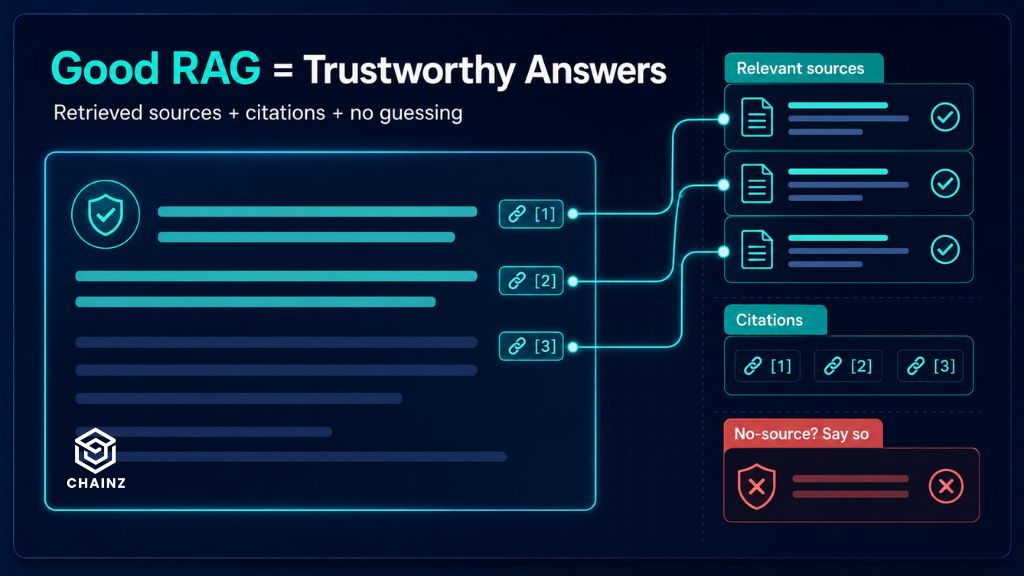
- Handling “I don’t know.” A good RAG chatbot says when the answer isn’t in its sources, rather than falling back to guessing – which defeats the purpose.
- Source citation. The best builds show where an answer came from, so users can verify and trust it.
That third point matters most. A RAG chatbot that still guesses when it can’t find an answer has quietly reintroduced the exact problem it was meant to solve.
How ChainZ Builds RAG Chatbots
We build RAG systems that are accurate by design — not confidently wrong. That starts with the unglamorous work most vendors skip: preparing and structuring your knowledge base so retrieval actually surfaces the right facts. We build in honest “I don’t know” behaviour and source citations, so your team and customers can trust what comes back. And because we’ve built AI infrastructure connecting hundreds of models in production, we choose the right approach for your accuracy, cost, and speed needs rather than defaulting to one.
You can explore our AI development services to see how we approach this, or read how much AI agent development costs in Australia if you’re planning the budget for an AI build.
Sitting on a pile of documents your customers or team keep asking about?
That’s exactly what a RAG chatbot turns into instant, accurate, sourced answers. Tell us what your knowledge base looks like and we’ll show you what a RAG assistant could do with it — and what it would take to build one that never guesses. Ask ChainZ about RAG →