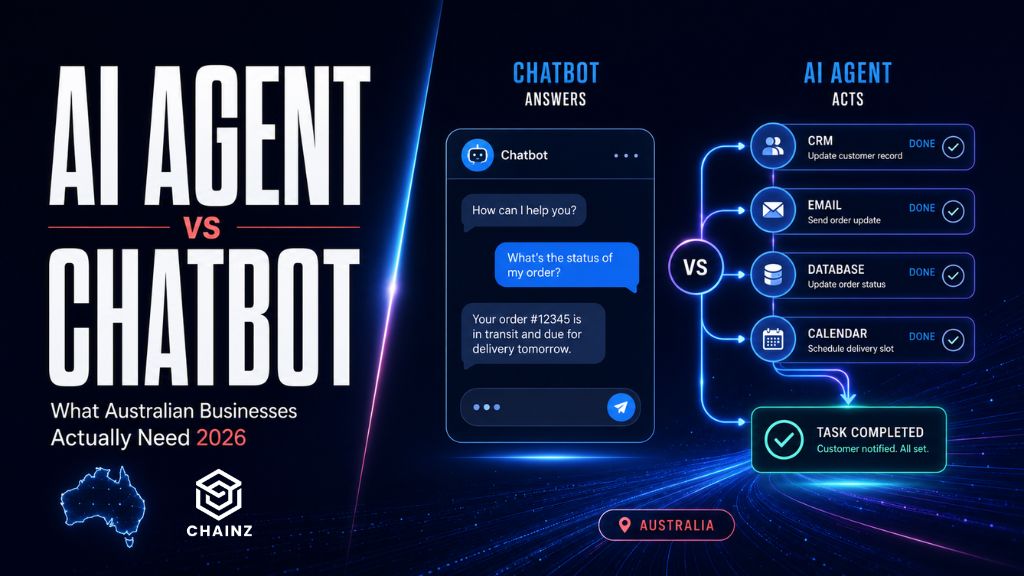
The simplest way to tell them apart: a chatbot answers, an AI agent acts. A chatbot responds to questions inside a chat window. An AI agent takes action across your business systems — reading a request, making a decision, updating records, and completing a task with little or no human involvement. A chatbot talks. An agent works.
That difference sounds small, but it changes everything: what each one can do for your business, how much it costs to build, and which one you actually need. This guide breaks it down in plain terms — and shows you how to spot the common trap of a chatbot being sold to you as an “agent”.
The Core Difference, in Plain English
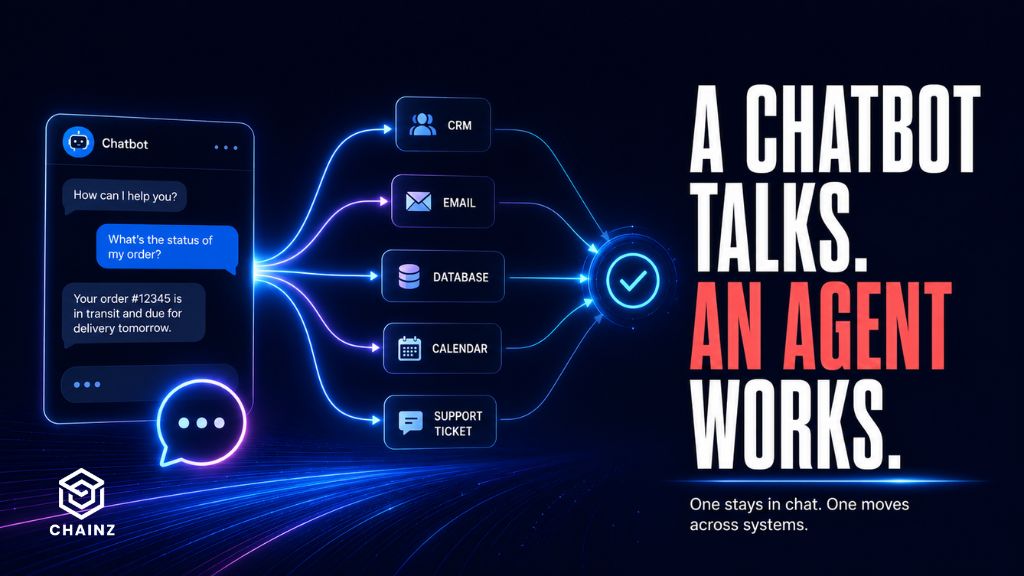
A chatbot is a conversation tool. It receives a message and returns a response — answering an FAQ, pointing someone to a page, or collecting a few details. Its world is the chat window.
An AI agent is a doer. It uses reasoning to work across multiple systems. For example, an agent might read an incoming email, look up the customer in your CRM, check the relevant policy, draft a reply, schedule a follow-up, and update the support ticket — in one pass, escalating to a human only on the steps that matter.
| Chatbot | AI Agent | |
|---|---|---|
| Core job | Answers questions | Completes tasks |
| Scope | Inside the chat window | Across your business systems |
| Decisions | Follows a script | Reasons through context |
| Systems it touches | Usually one (the chat) | Multiple (CRM, email, database) |
| Human involvement | Hands off when stuck | Acts autonomously, with approval gates |
| Typical cost | Lower | Higher (more engineering) |
It’s Actually a Spectrum, Not a Binary
Here’s what most articles miss: “chatbot” and “agent” aren’t two boxes — they’re two ends of a spectrum. Understanding where your need sits on it saves you from over- or under-building.
1. Rule-based chatbot. Follows a fixed script. “Press 1 for sales.” Cheap, predictable, but rigid — it breaks the moment a user goes off-script.
2. AI chatbot. Uses a language model to understand natural questions and answer flexibly from a knowledge base. Far better conversations, but still fundamentally answering — not acting.
3. AI assistant. Answers and performs limited actions in one system — booking a meeting, creating a ticket, looking something up live.
4. AI agent. Reasons across multiple systems and completes multi-step tasks end to end, making decisions along the way.
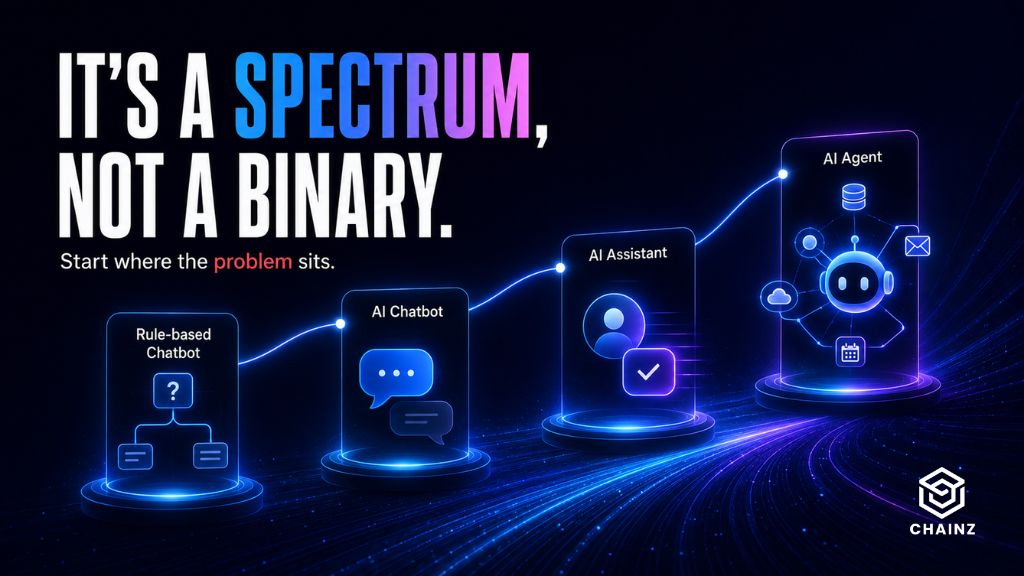
Most Australian businesses don’t need to jump straight to the far end. The smartest path is often to start where your problem actually sits and grow along the spectrum as the value proves out.
Which One Does Your Business Actually Need?
Skip the hype and answer three questions:
1. Does the job end with an answer, or with an action? If your customers mainly need information — opening hours, product details, “where’s my order” — a chatbot solves it. If the job requires doing something — processing a request, updating a system, completing a transaction — you need an agent.
2. Does it need to touch more than one system? If everything happens in the chat, a chatbot is enough. If the task spans your CRM, your inventory, your email, and your database, that’s agent territory.
3. How costly is a wrong action? A chatbot giving a slightly off answer is a minor annoyance. An agent taking a wrong action — refunding the wrong amount, updating the wrong record — has real consequences, which means more engineering, guardrails, and testing. The higher the stakes, the more you’re firmly in agent territory.
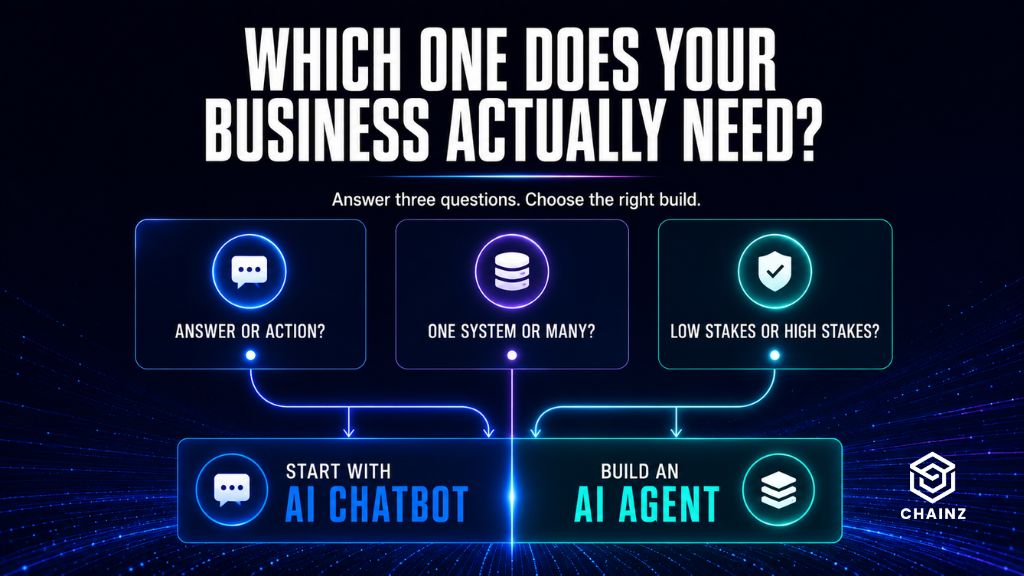
If you answered “answer / one system / low stakes” — start with an AI chatbot. If you answered “action / multiple systems / higher stakes” — you need an AI agent.
Why the Cost Is So Different
The price gap between a chatbot and an agent isn’t arbitrary — it reflects how much engineering sits behind each.
A chatbot is mostly about good conversation design and connecting to a knowledge base. An agent has to integrate with multiple systems, reason reliably, handle exceptions, and do all of it safely enough to act without a human watching every step. That’s a different class of engineering — which is why agents cost meaningfully more to build and run.
If you’re weighing the investment, our guide to how much AI agent development costs in Australia breaks down real 2026 figures, including the running costs most quotes leave out.
How to Spot a Chatbot Sold as an “Agent”
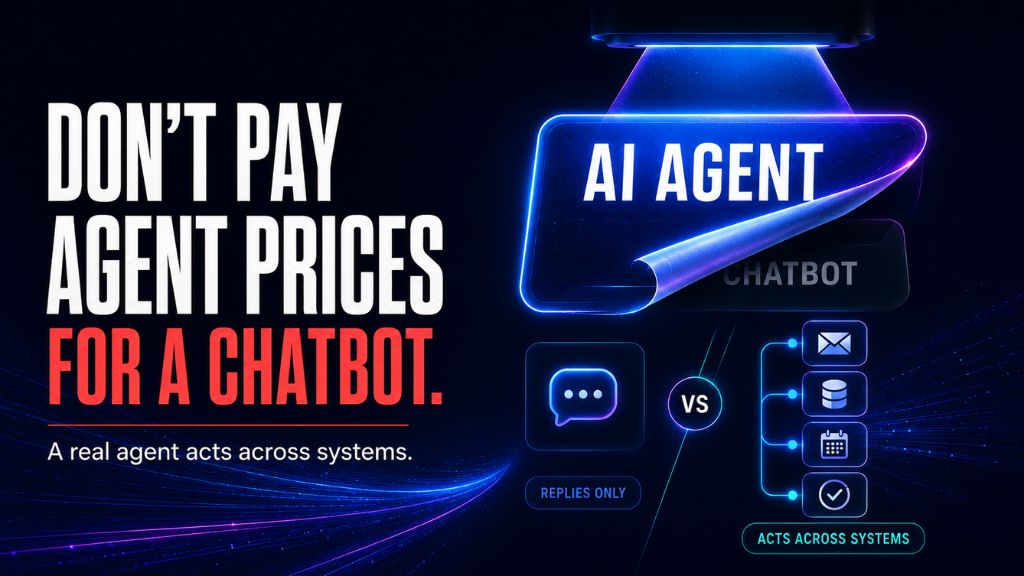
“AI agent” is the buzzword of the moment, and plenty of vendors now slap the label on what is really just a chatbot. Paying agent prices for chatbot capability is one of the easier ways to overspend. Here’s how to tell the difference before you sign:
| Ask the vendor | A real agent | A relabelled chatbot |
|---|---|---|
| “What systems does it act on?” | Names specific integrations (CRM, ERP, email) | “It answers questions on your site” |
| “What can it do without a human?” | Completes multi-step tasks | Only replies to messages |
| “How does it handle a decision?” | Reasons through context and exceptions | Follows a fixed flow |
| “What happens when it’s unsure?” | Escalates with full context attached | Just says “I don’t understand” |
If the answers all point back to “it responds to messages,” you’re being quoted for an agent and sold a chatbot. There’s nothing wrong with buying a chatbot — if that’s what you need and you’re paying chatbot prices for it.
Real Australian Scenarios
A retail business wants to cut “where’s my order” enquiries. The job ends with an answer pulled from one system. → AI chatbot.
A professional services firm wants incoming client requests triaged, logged in the CRM, assigned to the right person, and acknowledged automatically. The job spans multiple systems and ends with actions. → AI agent.
A SaaS company wants to answer product questions accurately from its documentation, and book demos for qualified leads. That’s answering plus one action. → AI assistant — the middle of the spectrum.
The right choice always comes from the job to be done, not the trend.
How ChainZ Approaches It
At ChainZ, we start with the problem, not the technology. We’ll tell you honestly whether your situation calls for a chatbot, an assistant, or a full agent — and we won’t quote you for an agent when a chatbot solves the job. We build production-grade AI systems for Australian businesses, with senior engineers and genuine AEST overlap so collaboration happens in real time.
You can explore our AI development services or book a discovery call to talk through which approach fits your business.
Not sure whether you need a chatbot or an AI agent? ChainZ helps Australian businesses make the right call — and build it properly. Book a free discovery call and we’ll tell you honestly which approach fits, with a realistic estimate within 2 business days.