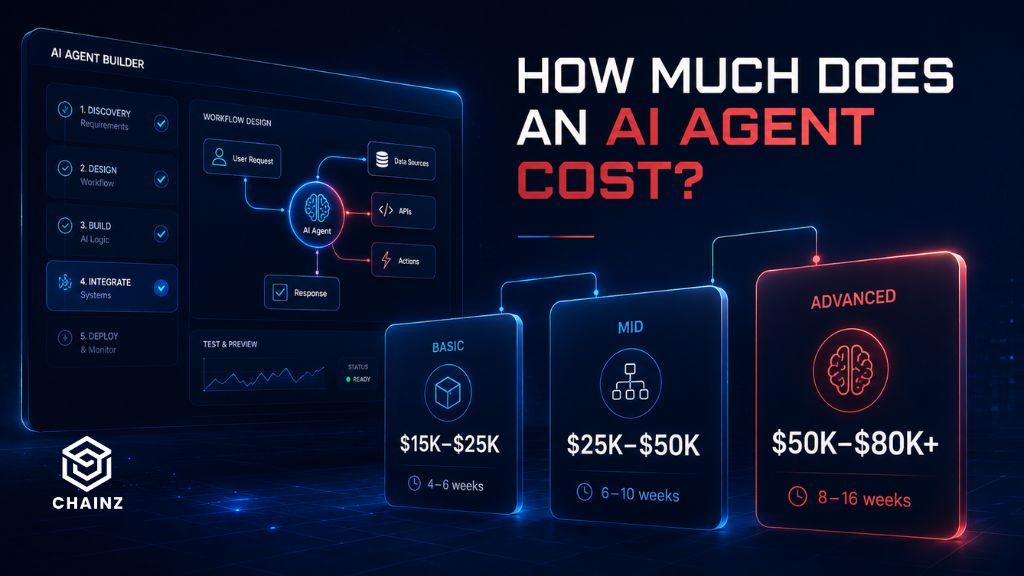
An AI agent in Australia typically costs between AUD $15,000 and $80,000. A simple single-task agent starts around $15,000–$25,000, while a complex agent with multiple integrations, custom workflows, and production-grade reliability can run $80,000 or more. The final figure depends on three things: how many systems it connects to, how much custom logic it needs, and the level of accuracy and security required.
If you’re an Australian business weighing up an AI agent, this guide breaks down exactly what you’re paying for, what changes the price, and how to avoid the most common (and expensive) mistake businesses make before they hire.
What Is an AI Agent — and Why It Costs More Than a Chatbot
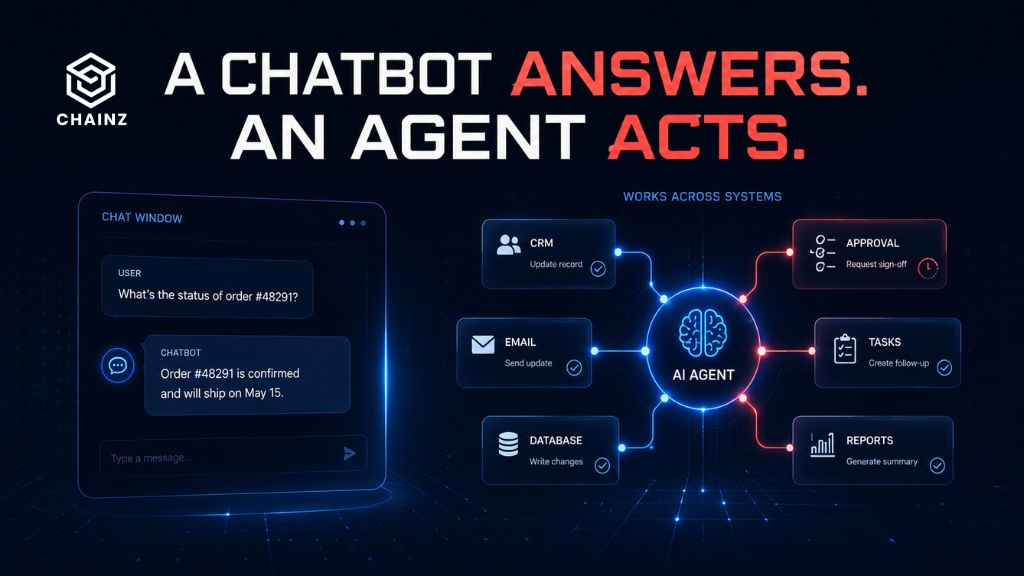
An AI agent is not a chatbot. A chatbot answers questions inside a chat window. An AI agent uses reasoning to take action across your business systems — reading a request, checking your CRM, applying a rule, updating a record, and notifying a person, all in one pass.
That difference matters for cost. A chatbot is a conversation. An agent is a worker that touches real systems, makes decisions, and has to be right every time. The engineering, testing, and safety work behind that is what you’re paying for.
AI Agent Development Cost in Australia: Price Breakdown
Here’s what Australian businesses can realistically expect in 2026:
| Type of AI Agent | Typical Cost (AUD) | Timeline | Best for |
|---|---|---|---|
| Basic single-task agent | $15,000 – $25,000 | 4–6 weeks | One clear workflow (e.g. support triage, FAQ resolution) |
| Mid-complexity agent | $25,000 – $50,000 | 6–10 weeks | Multiple integrations, custom logic, decision-making |
| Advanced / multi-role agent | $50,000 – $80,000+ | 8–16 weeks | Several systems, high accuracy, compliance, scale |
| Ongoing maintenance | $500 – $5,000 / month | Continuous | Monitoring, tuning, updates after launch |
These ranges line up with what specialist AI developers across Sydney, Melbourne, and Brisbane currently quote. Prices below this band usually mean a rule-based bot dressed up as an “agent” — not a system that can actually reason and act.
What Actually Drives the Cost
Five factors move the price more than anything else:
1. Number of system integrations. An agent that only talks to one tool is far cheaper than one connecting your CRM, ERP, accounting software, and email. Every integration adds engineering and testing time.
2. Complexity of the decisions. An agent following a simple “if this, then that” path is inexpensive. An agent that weighs context, handles exceptions, and reasons through ambiguity costs more — because that’s where the real engineering lives.
3. Accuracy and safety requirements. If a wrong answer is a minor inconvenience, testing is light. If a wrong answer touches money, customer data, or compliance, the system needs guardrails, human-in-the-loop approval, and audit trails — all of which add cost.
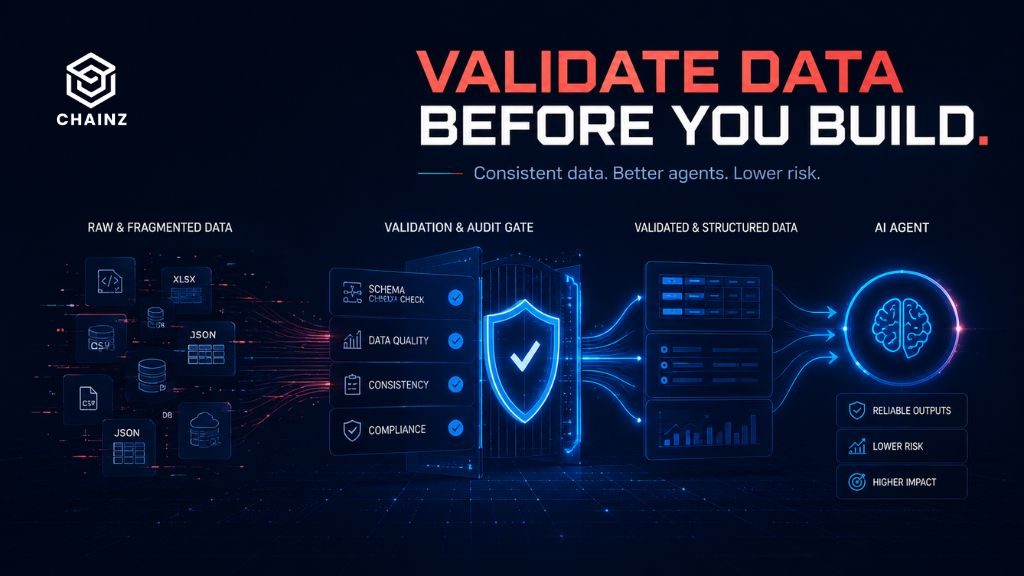
4. Data readiness. This is the hidden one. If your data is messy, inconsistent, or scattered, a large share of the budget goes to cleaning and structuring it before the agent can use it reliably.
5. Compliance with Australian regulations. Agents handling personal data must comply with the Australian Privacy Act 1988 and the Australian Privacy Principles — which means encryption, access controls, and secure hosting built in from day one.
The Running Cost Nobody Quotes You: API and Inference
Here’s the part most quotes leave out entirely. The build price is a one-time cost. But an AI agent that uses a large language model — GPT-4o, Claude, Gemini — has an ongoing per-use cost every single time it runs.
Every time your agent reads a request, reasons through it, and responds, it makes calls to an AI model that charges per token (roughly, per word processed). For a low-volume internal tool, this might be $50–$200 a month. For a customer-facing agent handling thousands of conversations, it can run $1,000–$5,000+ a month — sometimes more than the maintenance fee.
This is why a business can pay $30,000 to build an agent and then be blindsided by a $2,500 monthly API bill nobody mentioned. The running cost depends on:
- Volume — how many times the agent runs per month
- Model choice — top-tier models (GPT-4o, Claude Opus) cost far more per call than smaller, faster models
- Context size — how much information the agent reads each time (a RAG agent searching large documents costs more per call)
- Architecture efficiency — a well-engineered agent uses fewer, smarter calls; a poorly built one burns tokens on every step
A good development partner designs the architecture to minimise these running costs — choosing the right model for each task, caching where possible, and keeping prompts efficient. Ask any developer you’re evaluating to estimate your monthly API cost before you sign. If they can’t, they haven’t thought about it — and you’ll find out the hard way.
What an AI Agent Really Costs in Year One
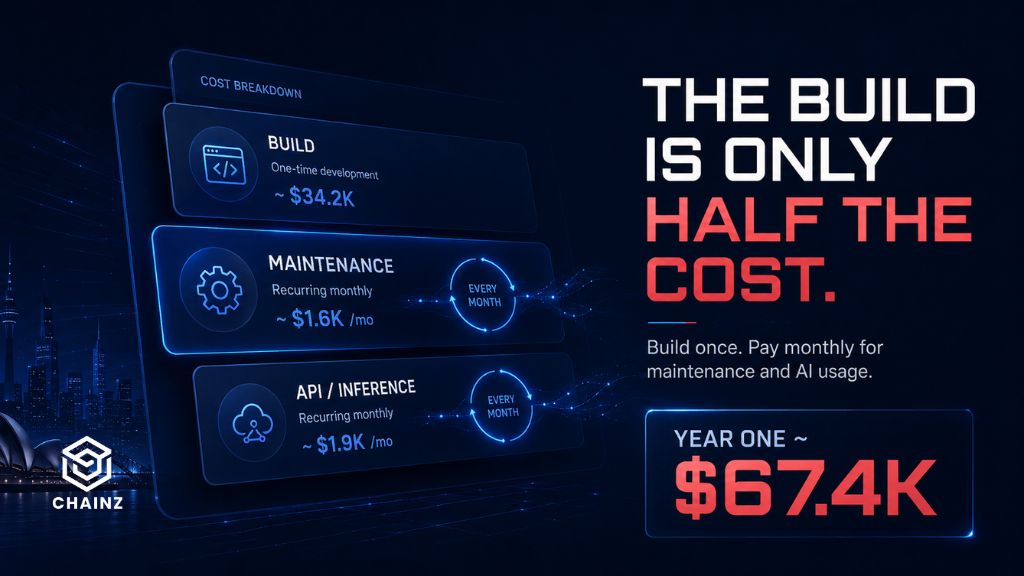
Most pricing articles stop at the build cost. But the number that actually matters for your budget is the first-year total cost of ownership — build, plus maintenance, plus running costs. Here’s a realistic picture for a mid-complexity customer-facing agent:
| Cost component | One-time / Monthly | First-year total (AUD) |
|---|---|---|
| Development (build) | One-time | $35,000 |
| Maintenance & monitoring | ~$1,500 / month | $18,000 |
| AI model API / inference | ~$1,200 / month | $14,400 |
| First-year total | ~$67,400 |
The build price was barely half the real first-year cost. This isn’t a reason to avoid AI agents — for the right use case, the return easily justifies it. It’s a reason to budget for the whole picture, not just the invoice to build it. Any partner worth hiring will walk you through all three numbers upfront.
Build vs Buy: When You Shouldn’t Pay for a Custom Agent
We’ll say the thing most development companies won’t: sometimes you shouldn’t build a custom AI agent at all.
If your need is genuinely simple and standard — a basic FAQ bot, a simple scheduling assistant, a single-channel support responder — an off-the-shelf platform may serve you well for a fraction of the cost. Paying $30,000 for something a $99/month tool already does is a waste.
Custom development earns its cost when:
- Your workflow is specific to how your business operates, not a generic template
- The agent needs to connect to your systems (CRM, ERP, internal databases)
- Accuracy, security, or compliance requirements rule out generic tools
- You need to own the system rather than rent it indefinitely
If an off-the-shelf tool genuinely solves your problem, a good partner will tell you — and point you to it. The right question is never “custom or off-the-shelf?” It’s “what’s the simplest thing that actually solves this?”
The Most Expensive Mistake: Hiring Before Validating Your Data
The single biggest way Australian businesses overpay is building an AI agent on top of data that can’t support it. A common pattern: a business commissions an impressive agent, then six months later finds it’s operationally useless because the underlying data was too inconsistent to produce reliable results.
Before you spend a dollar on development, ask one question honestly: do we have enough consistent, relevant data to support the outcome we want? If the answer is unclear, a short data audit is a far better first investment than a full build. A good development partner will tell you this upfront — not after the invoice.
Why the Right Engagement Model Matters for Cost
Where your development team sits has a major impact on both price and outcome:
- Local Australian hire: Highest cost. A senior AI developer in Australia can command $170,000+ per year. Makes sense only for long-term, deeply embedded capability.
- Offshore (no timezone overlap): Cheapest hourly rate, but collaboration stalls waiting for responses across a 24-hour gap — which slows projects and quietly adds cost.
- Nearshore / timezone-aligned team: The practical middle ground. Quality AI capability at a commercially sensible rate, with real-time collaboration during Australian business hours.
This is exactly where a timezone-aligned partner earns its place. Working on AEST overlap means same-day answers on architecture and data questions, rather than a project that stalls every time a question crosses a 24-hour window.
How to Read an AI Agent Quote (and Spot a Bad One)
When you get quotes, the price tag tells you less than how the quote is built. A trustworthy quote shows its working. Here’s what a good one includes — and the red flags that signal trouble:
| A good quote includes | Red flag |
|---|---|
| A breakdown of build vs maintenance vs API costs | A single lump sum with no breakdown |
| An estimate of monthly running (API) cost | No mention of ongoing inference cost at all |
| A data-readiness check before committing | “We can start immediately” with no data questions |
| Clear scope of what’s in and what’s out | Vague deliverables you can’t measure |
| Who owns the code at the end (you should) | Silence on code ownership and lock-in |
If a quote is suspiciously cheap, it usually means one of three things: it’s a rule-based bot mislabelled as an agent, the running costs have been hidden to make the build look affordable, or the scope is so vague you’ll be hit with change requests later. The cheapest quote is rarely the cheapest project.
How ChainZ Approaches AI Agent Development
At ChainZ, we build AI agents that run in production — not demos. We’ve architected systems that connect hundreds of services and handle real-world complexity, and we work on genuine AEST overlap so collaboration actually happens in real time.
Every project starts with an honest scope: we tell you whether an AI agent is the right solution, what it will realistically cost, and whether your data is ready — before any code is written. You can explore our AI development services or book a discovery call to get a realistic estimate for your specific use case.
Thinking about an AI agent for your business? ChainZ builds production-grade AI agents for Australian businesses — senior engineers, honest scoping, and real AEST overlap. Book a free discovery call and we’ll give you a realistic estimate within 2 business days.