
The MVP development cost in Australia typically starts from around $15,000 for a focused build and runs to $60,000 or more for something more ambitious, with most validated MVPs landing somewhere in between. But for a founder, the dollar figure is the second most important number. The first is this: how much do you need to spend to learn whether your idea works — and not a cent more?
That reframing is the whole point of an MVP, and it’s where most of the budget either gets used wisely or quietly wasted. This guide covers what an MVP actually is, what it should and shouldn’t include, the real costs in 2026, and how to build the right one without burning your runway.
What an MVP Actually Is (and What It Is Not)
A minimum viable product is the smallest version of your product that lets you test your core assumption with real users. The goal isn’t to launch a finished product — it’s to learn whether people want what you’re building, before you spend the full budget building it.
Here’s the trap that wrecks startup budgets: founders fall in love with the vision and try to build all of it, then call it an MVP. That isn’t an MVP — it’s a full product with a smaller name and a bigger invoice. The most expensive MVP is the one that includes features nobody needed yet, built before you knew if anyone wanted the core idea at all.
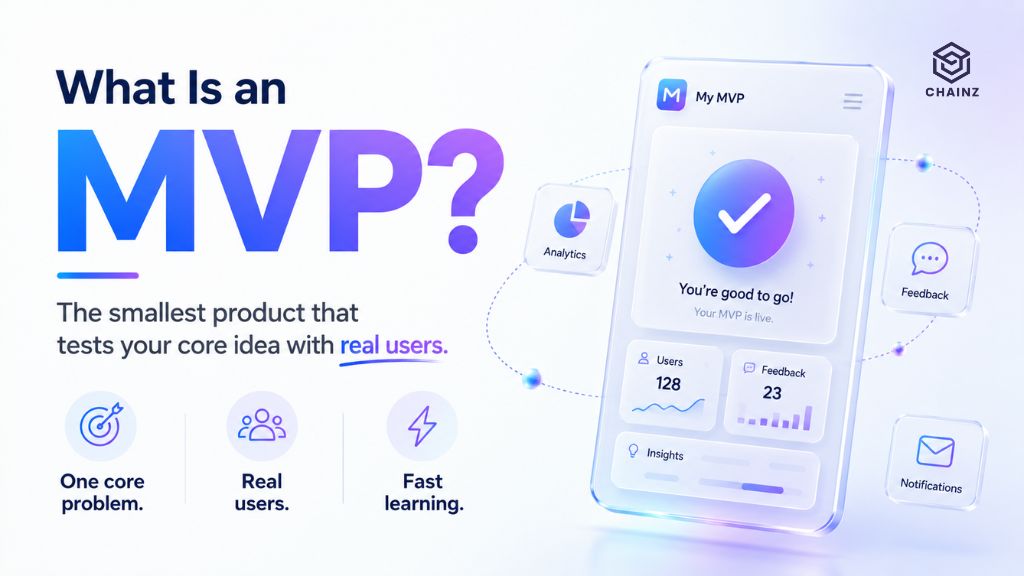
A real MVP does one thing well — the thing your entire business depends on being true.
MVP Development Cost in Australia: The Ranges
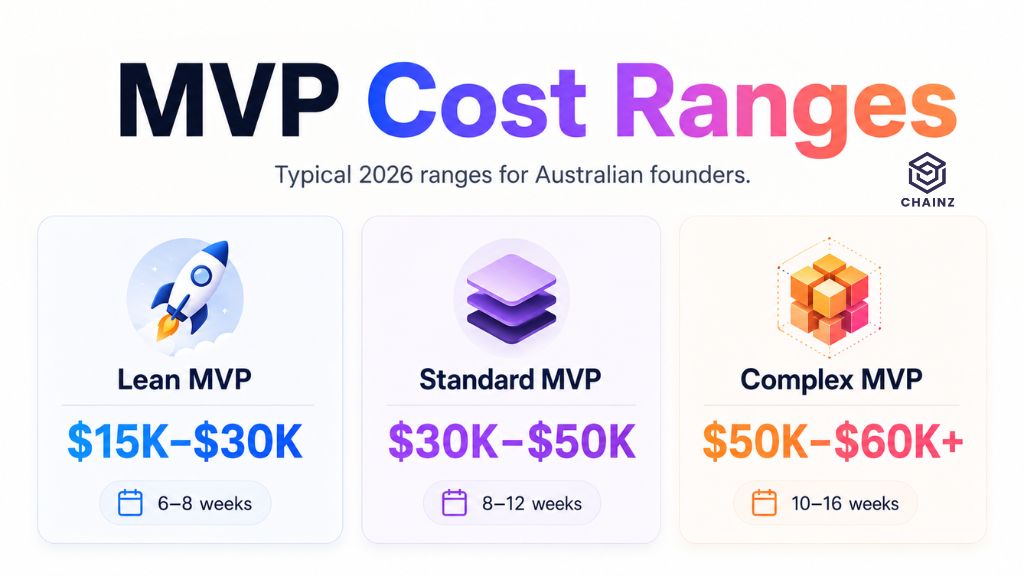
Here’s a realistic 2026 picture for Australian founders:
| MVP type | Typical cost (AUD) | Timeline |
|---|---|---|
| Lean MVP (one core feature, minimal screens) | $15,000 – $30,000 | 6–8 weeks |
| Standard MVP (core feature + supporting flows, auth, basic admin) | $30,000 – $50,000 | 8–12 weeks |
| Complex MVP (multiple user types, integrations, or AI features) | $50,000 – $60,000+ | 10–16 weeks |
If your MVP includes AI features, the cost of AI agent development in Australia is worth factoring in separately, as it carries ongoing running costs a standard build doesn’t.
If a quote for a “full-featured platform” comes in under these ranges, be cautious — either the scope is being underestimated, or you’re being sold a prototype that won’t survive real users. And if your MVP wish-list pushes the cost well above this band, that’s usually a signal to cut scope, not raise budget.
Why Building the Wrong MVP Costs More Than Building None
The real cost of an MVP isn’t just the build price — it’s the opportunity cost of building the wrong thing. Spend $50,000 and four months on features your users didn’t actually want, and you’ve lost more than the money: you’ve lost the runway and the time you needed to find product-market fit.
This is why the smartest founders treat scope discipline as the core skill of MVP development. Every feature you add before validation is a bet placed with money you can’t get back. The question for each one is brutal but simple: does the experiment fail without this? If not, it waits. Keeping that discipline is the single biggest lever on your MVP development cost in Australia — far more than any hourly rate.
How to Cut Scope to Hit Your Budget: Feature Triage
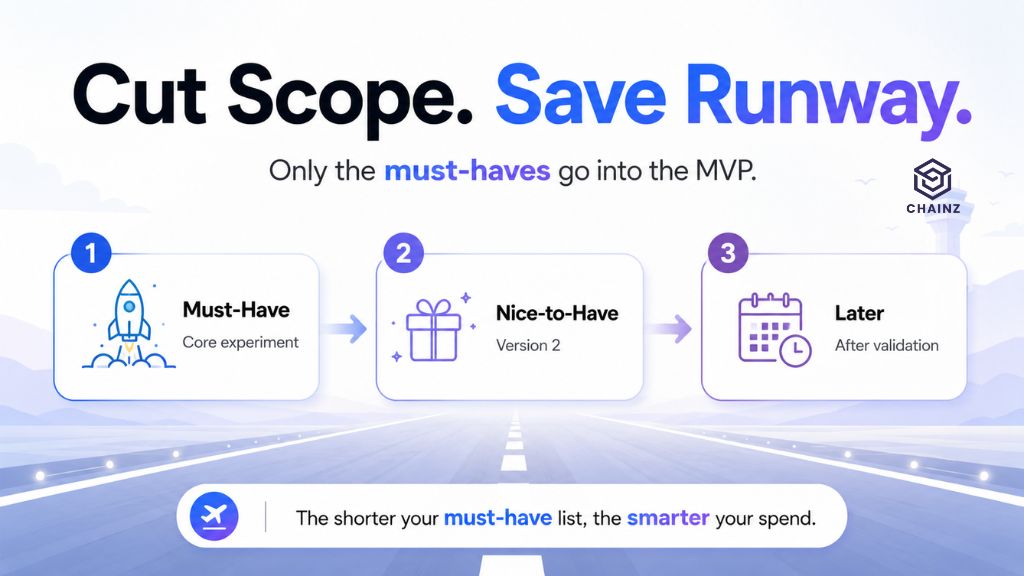
When your idea is bigger than your budget — which is almost always — you don’t need more money. You need to triage. Sort every feature into three buckets:
| Bucket | Definition | Goes in the MVP? |
|---|---|---|
| Must-have | The experiment fails without it | Yes — this is the MVP |
| Nice-to-have | Improves the product but doesn’t test the core idea | No — version 2 |
| Later | Matters only once you’ve proven demand | No — much later |
Most founders are shocked at how short the “must-have” list becomes once they’re honest. That short list is your MVP. Everything else is a decision you’ve earned the right to defer until users tell you it matters. This single exercise is the difference between a $20,000 MVP and a $60,000 one — for the same validated learning.
The Cost Founders Forget: Runway to Iterate After Launch
Here’s the mistake that catches even experienced founders: spending the entire budget on the build, leaving nothing for what comes after. An MVP’s job is to generate learning — and that learning is useless if you can’t afford to act on it.
After launch, you’ll need to iterate: fix what users struggle with, build the features they actually ask for, and refine based on real behaviour. Budget for that. A useful rule of thumb is to reserve enough runway to fund two or three rounds of iteration after the MVP ships. Spending 100% of your money to reach launch day and 0% on what you learn there is how good ideas die at the finish line.
Why Fixed-Price Suits MVPs Specifically
For most software, a hybrid pricing model works best. MVPs are the exception — they’re one of the few project types where fixed-price genuinely fits, and here’s why.
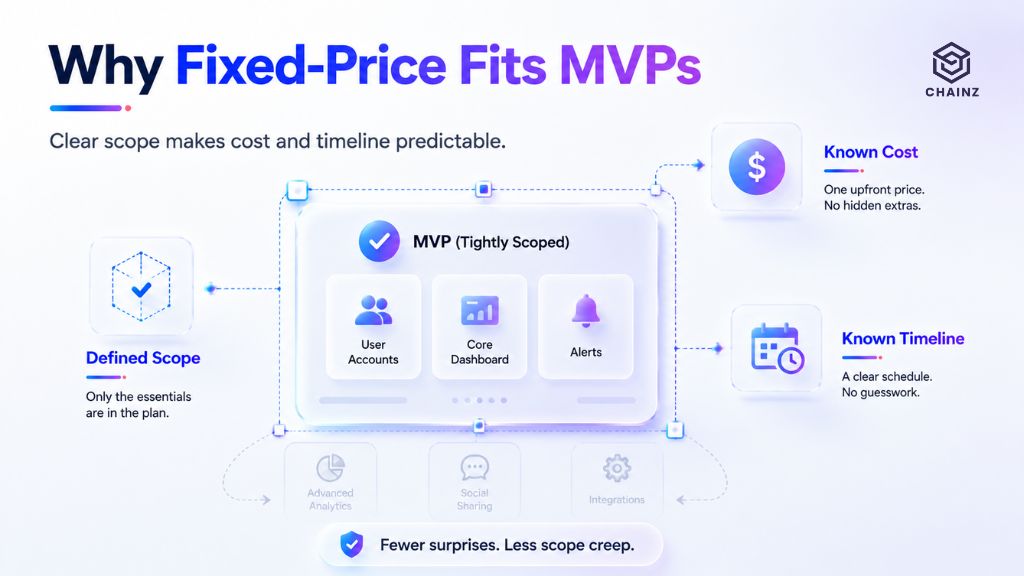
An MVP should have a tightly defined scope by design. You’ve already triaged it down to the must-haves, so the requirements are clear and contained. That clarity is exactly the condition fixed-price needs to work fairly. A fixed-price MVP gives a founder what they need most: a known cost, a known timeline, and the discipline to resist scope creep — because every addition becomes a visible, deliberate decision rather than a quiet budget leak.
How ChainZ Builds MVPs
We build MVPs the way founders actually need them built: a fixed scope, a fixed price, and shipped in weeks, not quarters. Before anything is built, we help you triage your feature list down to the must-haves — and we’ll push back if you’re trying to build version 3 and call it an MVP. Just as importantly, we architect the MVP to be extended, not thrown away, so the version that proves your idea becomes the foundation you grow on rather than a dead end you rebuild.
If you’re planning the full build that follows a successful MVP, our guide to custom software development costs in Australia covers what comes next, and you can see how we structure projects on our software development services page.
Got an idea but not sure what the smallest version looks like? That’s the most valuable conversation a founder can have before spending a dollar. Tell us your idea and we’ll help you triage it down to a real MVP — the must-haves, a realistic cost, and a timeline — so you know exactly what to build first. Scope your MVP with ChainZ