
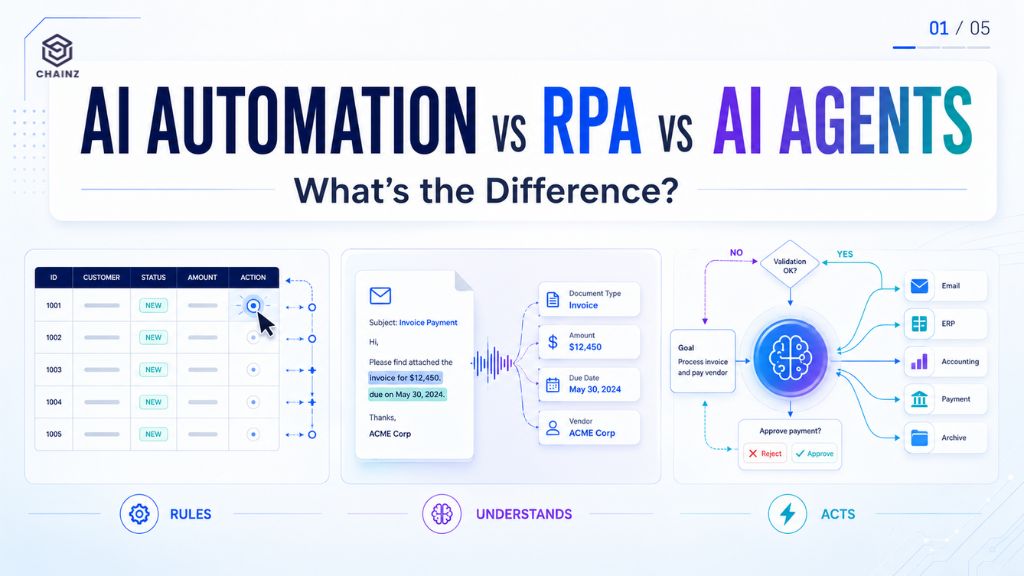
The debate over AI automation vs RPA usually gets framed as old technology versus new — as if one has replaced the other. It hasn’t. RPA follows fixed rules on structured data and does it cheaply and reliably. AI automation handles the messy, language-based work rules can’t describe. AI agents go further again, reasoning through decisions and acting across systems. Three different tools for three different jobs.
Choosing wrong is expensive in both directions: pay for an AI agent to do what a simple script handles, and you’ve overspent; force RPA onto a task that needs judgment, and you’ll spend the next year fixing broken bots. This guide explains what each one actually is, how to tell which your process needs, and why the real answer for most businesses is a combination.
The Three Tools, Plainly Explained
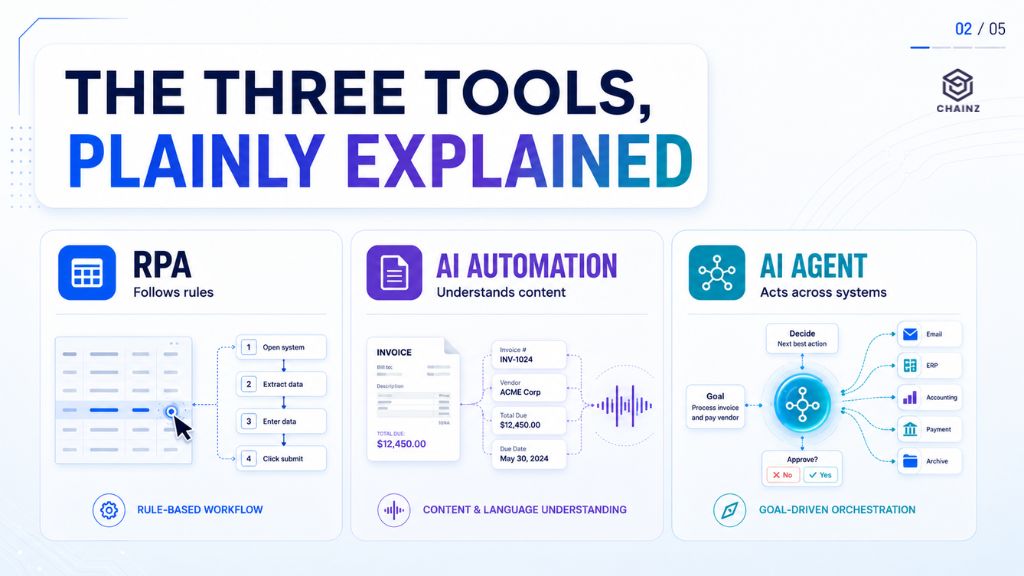
RPA (Robotic Process Automation) is a software robot that follows the exact steps you record. Open this system, copy that field, paste it there, click submit. It’s fast, cheap to run, and completely predictable — as long as nothing changes. RPA doesn’t understand what it’s doing; it repeats what it was told.
AI automation brings understanding to the process. Instead of following fixed steps, it interprets content — reading an unstructured invoice, classifying an email by its meaning, extracting key terms from a contract, or drafting a reply. It handles the variation that breaks rule-based systems.
AI agents add reasoning and initiative. An agent works out how to complete a goal, chains multiple steps together, handles exceptions, and acts across several systems — updating a CRM, sending a notification, escalating what it can’t resolve.
| RPA | AI automation | AI agent | |
|---|---|---|---|
| Works on | Structured, predictable data | Unstructured content, language | Multi-step goals across systems |
| How it decides | Fixed rules you define | Interprets meaning | Reasons through context |
| Handles exceptions | No — it breaks | Somewhat | Yes, by design |
| Running cost | Very low | Per-use model fees | Higher per-use fees |
| Breaks when | The screen or format changes | Inputs fall far outside training | Rarely — but needs guardrails |
| Best for | High-volume, identical tasks | Documents, email, text | Judgment-based workflows |
The Trade-off Nobody Mentions: Brittleness vs Running Cost
Every comparison of AI automation vs RPA lists the features. Far fewer explain the trade-off that actually determines your total cost over three years.
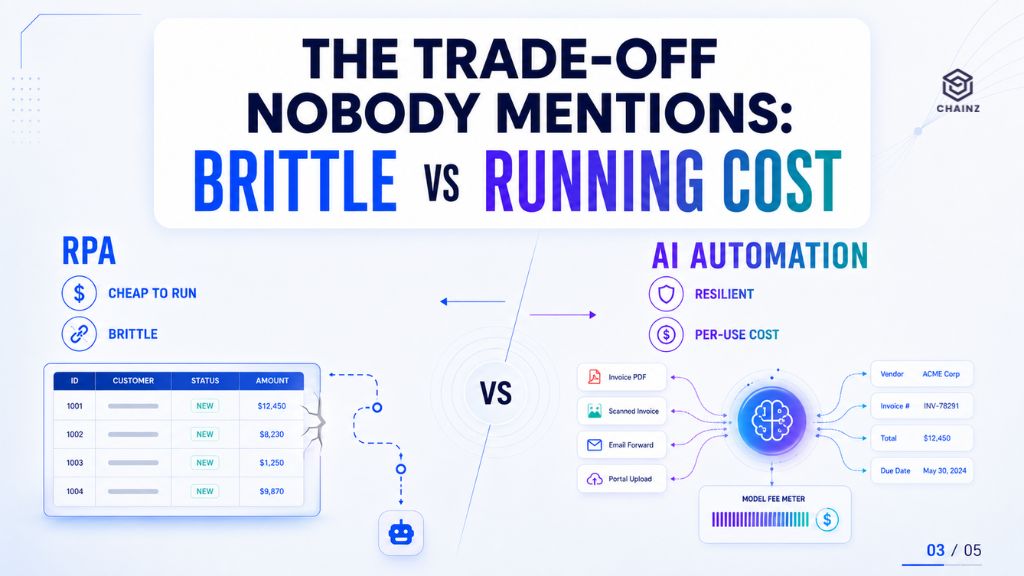
RPA is cheap to run but brittle. A bot costs almost nothing per execution — but it’s tied to the exact screen layout and file format it was built against. When a vendor updates their interface, or a supplier changes their invoice template, the bot breaks silently. Many businesses discover that maintaining an RPA estate quietly consumes more budget than building it did.
AI automation is resilient but has a per-use cost. It handles variation gracefully — a new invoice layout is no problem, because it reads meaning rather than pixel positions. But every execution calls a language model, and that carries a fee. At low volume it’s trivial; at very high volume it becomes a real line item.
That trade-off gives you a simple rule of thumb: high volume with genuinely stable inputs favours RPA. Variable inputs favour AI, almost regardless of volume — because the maintenance cost of brittle automation on unstable inputs will exceed the running cost of AI every time.
Which One Does Your Process Need? Four Questions
Skip the technology and interrogate the task:
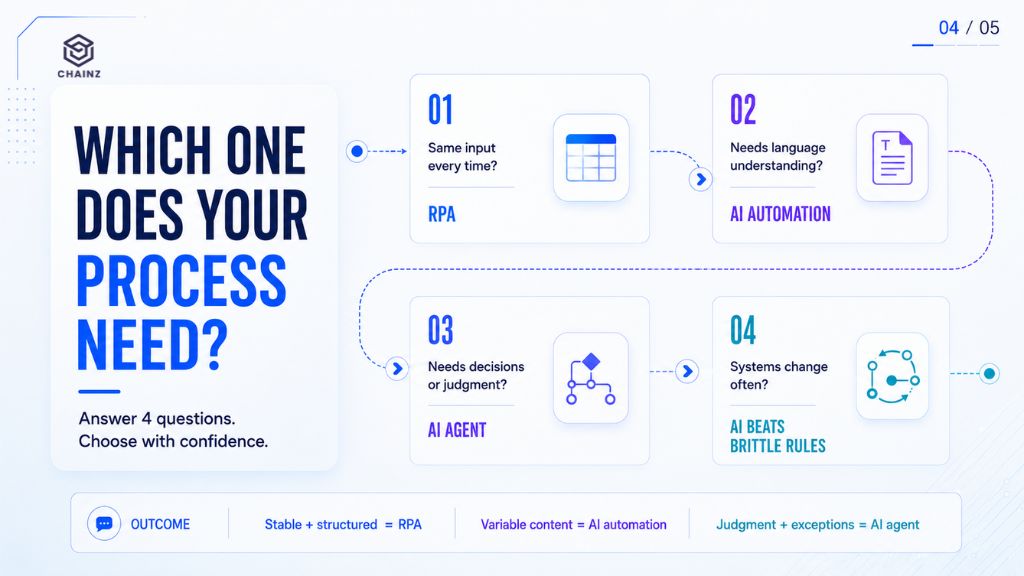
1. Is the input always the same shape? If every record arrives in an identical format from the same system, RPA is likely enough. If the input varies — different layouts, free text, human writing — you need AI.
2. Does the task require understanding language or meaning? Reading, classifying, summarising, or writing means AI. Moving structured data from A to B means RPA.
3. Does anything need to be decided? If a human currently exercises judgment at any step, rules won’t capture it. That’s agent territory.
4. How often does the process or its systems change? Frequent change punishes RPA severely. The more volatile your environment, the more AI’s flexibility earns its running cost.
The Real Answer: Most Businesses Need a Combination
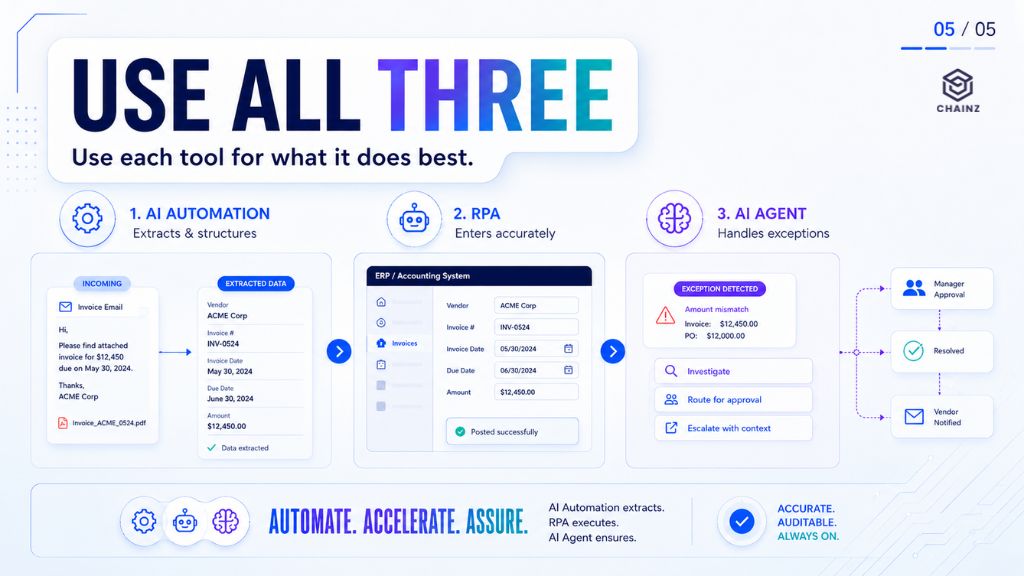
Here’s what gets lost in the versus framing. In practice, the strongest automation architectures layer all three, using each for what it’s genuinely good at.
A realistic invoice-processing workflow looks like this: AI reads the incoming invoice and extracts the fields regardless of supplier format. RPA takes those clean, structured fields and enters them into your accounting system — cheap, fast, reliable, because the data is now predictable. An AI agent handles the exceptions: a mismatch against the purchase order, an unfamiliar supplier, an amount over threshold. It investigates, resolves what it can, and escalates the rest with full context attached.
Each tool does the part it’s best at. You’re not paying model fees for simple data entry, and you’re not asking a brittle bot to interpret a document it’s never seen. That layering — not picking a winner — is what a well-designed automation actually looks like. It’s also the reasoning behind our approach to process automation and system integration.
“We Already Have RPA — Do We Throw It Away?”
Almost never, and this is worth saying clearly because a lot of vendors imply otherwise.
If you’ve invested in RPA and the bots are working, the sensible move isn’t replacement — it’s targeted augmentation. Find the points where your bots break most often or where humans still intervene, and put AI at exactly those points. The bot keeps doing the reliable, structured work it does cheaply; AI handles the variation that was causing failures.
This is usually the highest-return automation project a business can run, because you’re not rebuilding what already works. You’re removing the specific friction that makes it unreliable. Anyone recommending you rip out a functioning RPA estate to “go AI” is selling a project, not solving a problem.
Where the Boundaries Blur
One honest caveat: these categories overlap more than any comparison table suggests, and the vendor landscape blurs them deliberately. Many modern RPA platforms now bundle AI features. Many “AI automation” tools are mostly rules with a language model bolted on one step. And “agent” has become the most abused label in the industry — plenty of tools sold as agents simply follow a fixed flow.
The practical defence is to ignore the label and ask what the system actually does when something unexpected arrives. Does it reason, or does it fail? That single question separates the categories far more reliably than any product name. The same test applies when you’re weighing an AI agent against a chatbot.
How ChainZ Approaches This
We’re deliberately tool-agnostic — we don’t sell AI when a simpler automation does the job better and cheaper. Every engagement starts by mapping the actual process: where the inputs vary, where humans intervene, where things break. Only then do we decide what belongs to RPA-style rules, what needs AI, and what genuinely requires an agent. Sometimes the honest answer is that a well-written script solves it and you don’t need us for the rest.
If you’re budgeting for the AI portion of a build, our breakdown of AI agent development costs in Australia covers both the build and the ongoing running costs that shape this decision.
Pick one process that frustrates your team and send it to us.
Describe how it works today — the steps, where it breaks, where someone has to step in. We’ll map it back to you showing which parts suit rules, which need AI, and which need an agent, along with a rough sense of what each would cost. It’s a useful document whether or not you build it with us. Map a process with ChainZ →