
Most AI projects get approved on a feeling rather than a figure. Someone estimates that automation will “save a lot of time,” a budget is signed off, and nobody revisits the numbers until the invoice arrives. Calculating AI ROI properly isn’t complicated — but it does require accounting for two things most business cases quietly leave out: the ongoing running cost of the AI itself, and how long it takes before the savings actually start.
This guide gives you a straightforward way to build that number before you commit, and to check it honestly afterwards.
Why Most AI Business Cases Are Wrong
The typical calculation looks reasonable: this task takes 20 hours a week, the AI will remove 80% of it, so we save 16 hours a week. Multiply by an hourly rate, compare against the build cost, and the payback looks fast.
Three things break that maths in practice.
The running cost is missing. Unlike traditional software, AI carries a per-use fee. Every time the system processes a document or answers a question, it calls a model that charges for it. A build costing $40,000 might carry $1,500 a month in model fees — $18,000 a year that never appeared in the business case.
“Hours saved” isn’t money saved. Freeing 16 hours a week only produces a return if those hours go somewhere valuable. If the team simply absorbs the slack, you’ve improved conditions — a real benefit, but not one that shows up in the accounts. Be honest about which you’re buying.
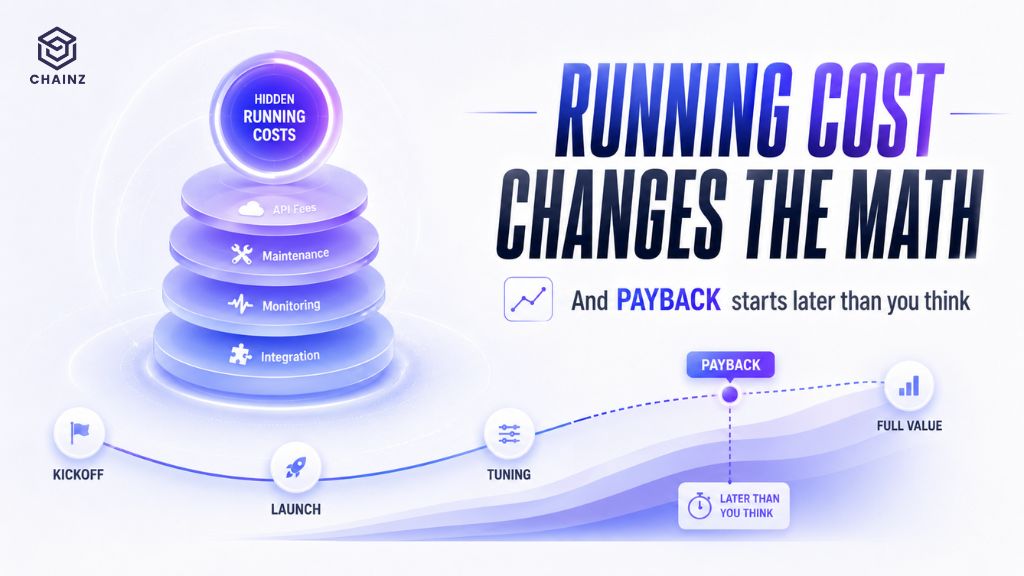
Time-to-value is assumed to be zero. Savings don’t begin on launch day. There’s a build period, then a tuning period where accuracy improves and staff adapt. Real returns typically start months after the project begins.
A Simple Framework for Calculating AI ROI
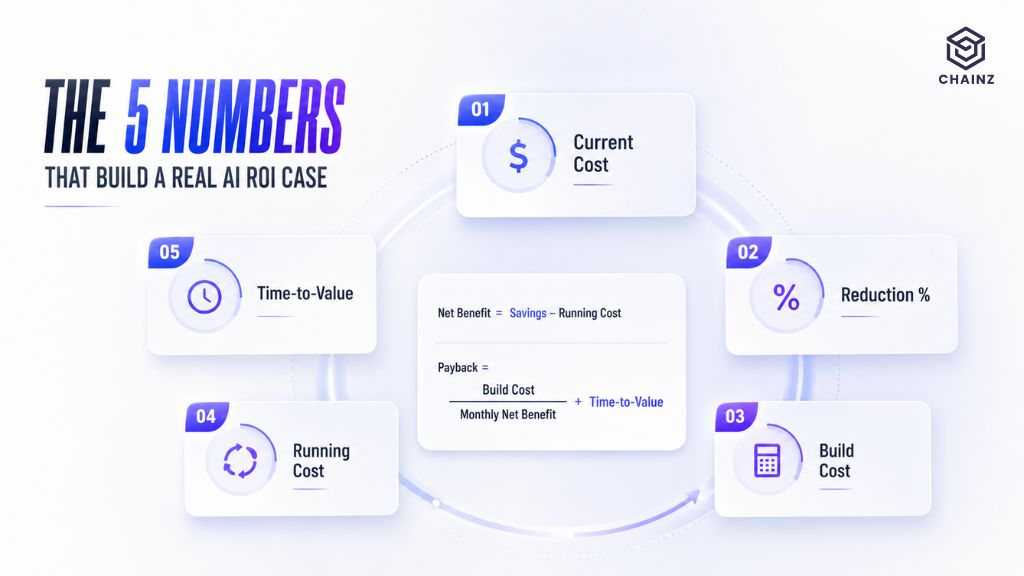
Work through five numbers. If you can’t fill one in, that gap is itself useful information.

1. Current cost of the problem (annual).
What does this task cost you today? Count hours across everyone involved, multiply by a loaded hourly rate, and add downstream costs — errors, rework, delays, missed opportunities. This is the number you’re trying to reduce.
2. Realistic reduction (not elimination).
AI rarely removes 100% of a task. Assume 60–80% for a well-suited process, and account for the human oversight that remains. If your business case only works at 95% automation, it doesn’t work.
3. Build cost (one-time).
The development investment, including discovery and data preparation. Be aware that data cleaning is frequently the largest and most underestimated line.
4. Annual running cost.
Model/API fees plus maintenance and monitoring. As a planning figure, budget model fees based on your expected transaction volume, and maintenance at roughly 15–20% of build cost per year.
5. Time-to-value (months).
Build time, plus a tuning period before the system performs at target. Six months from kickoff to full value is a realistic assumption for a mid-complexity project.
The calculation:
Annual net benefit = (Current annual cost × realistic reduction %) − annual running cost
Payback period = Build cost ÷ (Annual net benefit ÷ 12) + time-to-value
A worked example: a process costing $180,000 a year, with a 70% realistic reduction, gives $126,000 in gross annual saving. Subtract $30,000 in annual running and maintenance costs and the net benefit is $96,000. Against a $60,000 build, that’s a payback of about 7.5 months of operation — call it 12 months from kickoff once time-to-value is included. That’s a strong case, and it’s strong because the uncomfortable numbers are in it.
The Costs That Get Left Out
Beyond model fees, four costs routinely go missing from AI business cases:
- Data preparation. Often the single largest hidden cost. If your data is inconsistent or scattered, cleaning it can exceed the build itself.
- Change management. Staff need to trust and adopt the system. Budget for training and for the productivity dip during transition.
- Ongoing accuracy work. Real-world usage surfaces edge cases. Someone needs to monitor and tune.
- Integration maintenance. When connected systems update, integrations need attention.
None of these are reasons to avoid AI. They’re reasons to put a real number on the whole picture rather than a flattering slice of it. Our AI agent cost guide breaks down build versus running costs in more detail.
Not Everything Valuable Is Measurable — Say So Explicitly
Some genuine benefits resist a dollar figure: faster customer response times, fewer errors in compliance-sensitive work, better staff retention because people stopped doing soul-destroying manual tasks, or the capacity to take on more clients without hiring.
The mistake isn’t including these — it’s blending them into the financial case to make the numbers work. Keep two separate columns: the hard financial return, and the strategic benefits stated plainly as qualitative. A business case that says “this pays back in 14 months, and separately improves response times and staff experience” is far more credible than one that inflates soft benefits into dollars to hit a target. Decision-makers can smell the difference.
Measuring After You Build: Baseline Before, Not After
Here’s the practical failure that undermines most post-launch measurement: nobody recorded the “before” properly.
Once the AI is live, the old process is gone and memories are generous. Without a baseline captured beforehand, you’re comparing today’s numbers against an estimate of the past — which is not measurement.
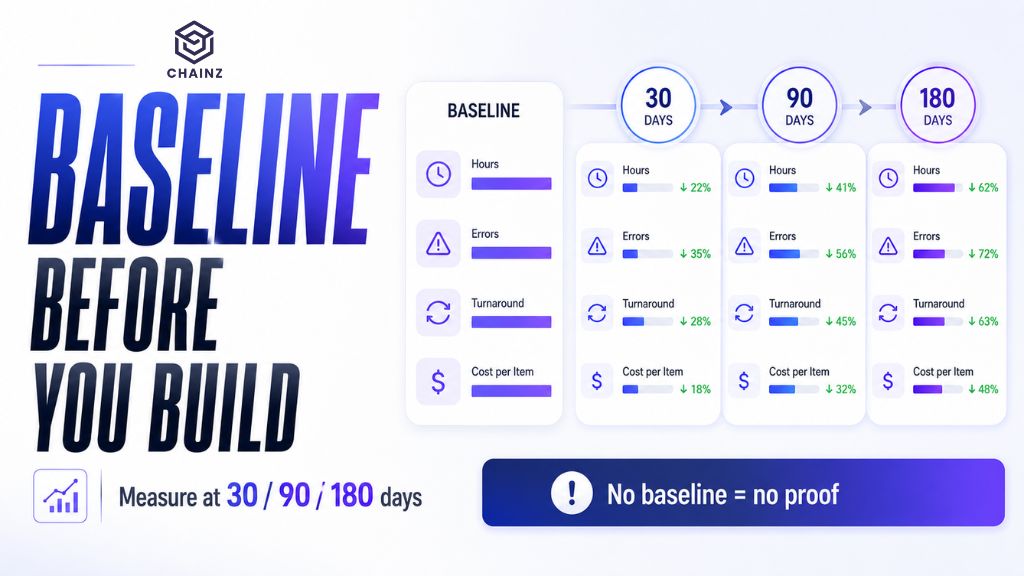
Before development starts, capture the current state precisely: how many hours the task takes, how many items are processed, the error rate, the turnaround time, and the cost per item. Freeze those figures in writing. Then measure the same metrics at 30, 90, and 180 days after launch.
That last point matters. Measuring only at 30 days will understate the return, because the system is still being tuned and staff are still adapting. Measuring only once, ever, tells you nothing about whether the benefit held.
When the Honest Answer Is “Don’t Build It”
An ROI framework is only useful if you’ll accept a negative result. Some signals that a project shouldn’t proceed:
- The payback period stretches beyond two to three years
- The case only works at unrealistically high automation rates
- The problem is too small — you’re automating something that costs $15,000 a year with a $50,000 build
- Your data can’t support reliable results, and fixing it costs more than the return
- The “saved hours” have nowhere valuable to go
The best outcome of a rigorous AI ROI analysis is sometimes a project that doesn’t happen. That’s a saved budget, not a failure — and it frees the money for a use case where the numbers genuinely work.
How ChainZ Handles This
We’d rather lose a project than build one that doesn’t pay for itself. Before scoping any build, we help you put real numbers around the problem — including the running costs and data preparation that make quotes look attractive when they’re excluded. If the maths doesn’t work, we say so, and we’ll often point to a smaller intervention that does. That’s a shorter conversation and a better outcome than an impressive system nobody can justify twelve months later.
If you’re weighing up where AI genuinely fits, our generative AI integration guide covers which use cases tend to produce returns and which are usually hype.
Run the numbers before you run the project.
Send us the process you’re considering automating and we’ll build the ROI model with you — current cost, realistic reduction, running costs, and payback period. If it doesn’t stack up, we’ll tell you that, and you’ll have saved yourself a budget. Build your ROI case with ChainZ →