
Most AI projects that fail don’t fail because the technology didn’t work. They fail because the data underneath it couldn’t support the result anyone was promised. Data readiness for AI is the least glamorous part of any AI project and the single strongest predictor of whether it will succeed — which is exactly why it gets skipped in favour of choosing a model.
This guide gives you a practical way to assess your own data before you commit a budget, including the check that matters more than any technical audit: whether the data can actually answer the question you’re asking of it.
Why Data Is Where AI Projects Actually Fail
A language model can be world-class and still produce useless output if what you feed it is inconsistent, incomplete, or scattered across systems that don’t agree with each other. The AI isn’t broken — it’s faithfully reflecting the state of your information.
The pattern is depressingly consistent. A business commissions an impressive-sounding build. Months in, the outputs are unreliable in ways nobody can quite fix. Investigation reveals the real problem: three systems recorded customers differently, half the historical records are missing key fields, and the labels people applied were never consistent. None of that was visible at the proposal stage, and none of it is a modelling problem.
The uncomfortable truth is that data preparation is routinely the largest line item in an AI project — and the one most often left out of the quote entirely.
The Data Readiness Checklist
Work through these seven checks honestly. You don’t need a data team to do it — you need to be willing to hear an unwelcome answer.
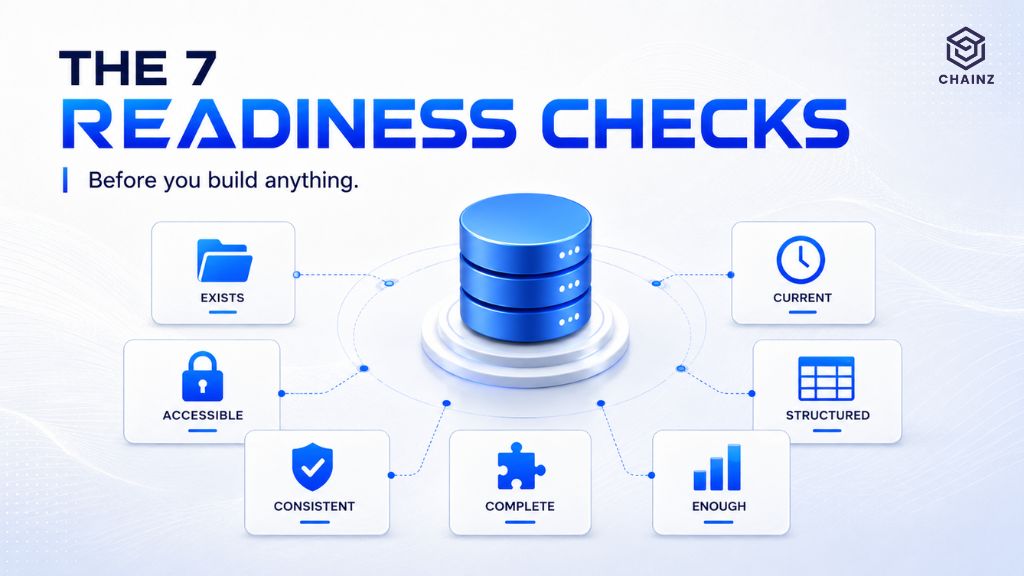
1. Does the data exist at all?
Not “could we get it” — does it exist now, in a form someone can access? Plenty of projects are scoped around data the business assumes it has and doesn’t.
2. Is it accessible?
Locked inside a legacy system with no export, held by a vendor who won’t release it, or trapped in a format nobody can read — inaccessible data is functionally non-existent for an AI project.
3. Is it consistent?
Does the same thing get recorded the same way every time? Different date formats, three spellings of the same supplier, free-text where a category should be — inconsistency is the most common and most expensive problem you’ll find.
4. Is it complete enough?
Missing values in critical fields will limit what’s possible. The question isn’t whether there are gaps — there always are — but whether the gaps sit in the fields that matter for your use case.
5. Is there enough of it?
Volume requirements vary enormously by use case. A retrieval system answering from your documents needs comparatively little; a predictive model learning patterns needs substantially more. If you have a few dozen historical examples of something you want predicted, rules will serve you better than machine learning.
6. Is it current?
Stale data produces confident, outdated answers. If your policy documents haven’t been updated in three years, an AI trained on them will cheerfully quote obsolete policy to your customers.
7. Is it labelled or structured usefully?
For some use cases, raw data is fine. For others, you need labelled examples — and if humans have been labelling inconsistently, the AI will learn that inconsistency perfectly.
The Check That Matters More Than the Rest
Here’s the question that would prevent more failed AI projects than every technical audit combined:
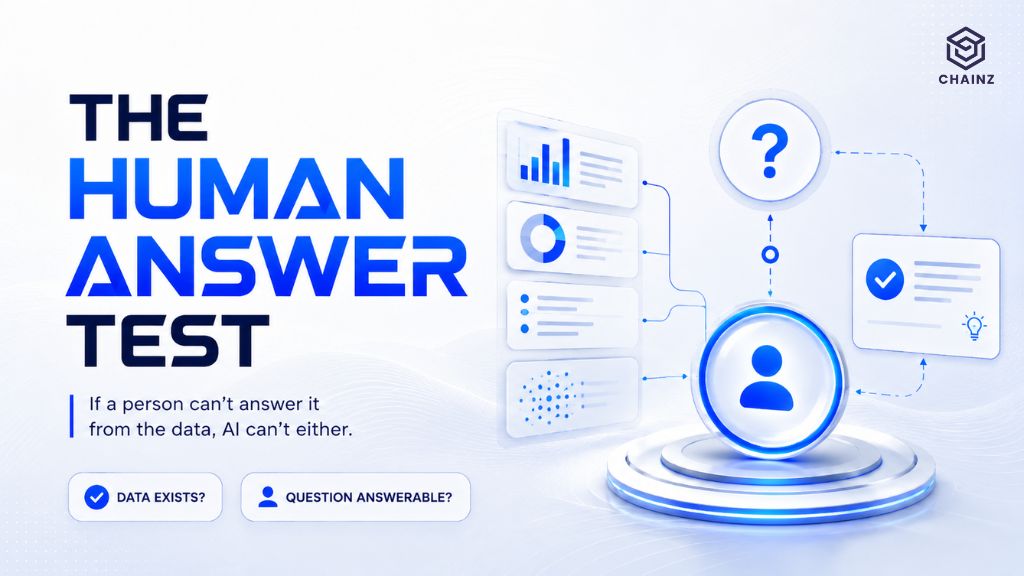
Could a competent human answer this question using only the data you have?
If you handed a smart new employee your complete dataset and asked them to produce the outcome you want from the AI, could they do it? If the answer is no — because the information simply isn’t in there — then no model will find it either. AI can find patterns humans miss, but it cannot recover information that was never recorded.
This is the test that catches the most expensive category of failure: not messy data, but absent data. A business wants to predict which customers will churn, but never recorded the signals that precede churn. A business wants AI to route enquiries by urgency, but urgency was never captured anywhere. The data is clean, plentiful, and accessible — and it still can’t answer the question.
Run this test first. It takes ten minutes and it costs nothing.
Different Use Cases, Different Requirements
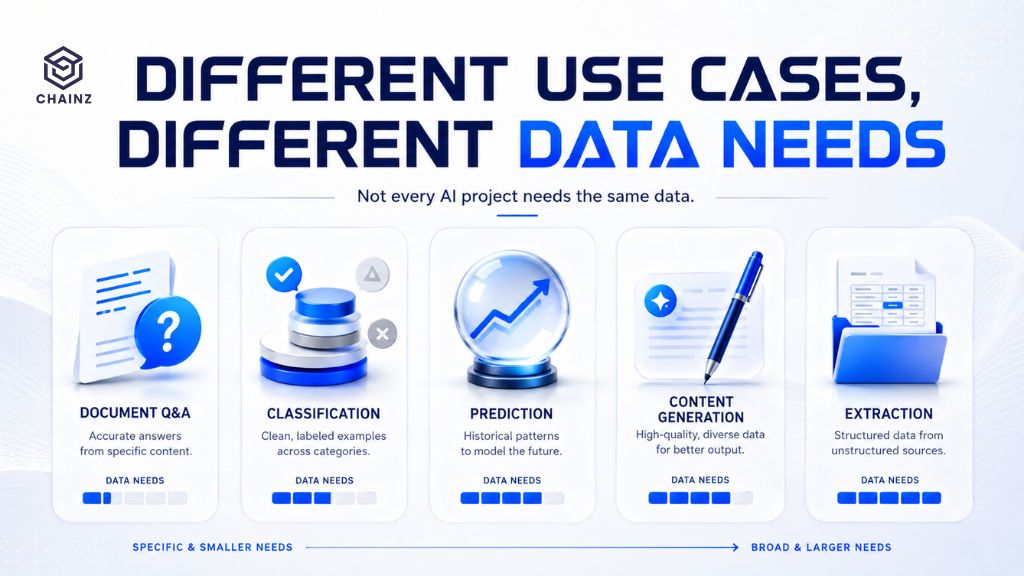
Data readiness isn’t a single bar to clear — the requirements vary sharply by what you’re building.
| Use case | What it needs from your data | Tolerance for mess |
|---|---|---|
| Document Q&A / RAG | Current, accurate documents; structure helps | Moderate — quality matters more than volume |
| Classification / routing | Consistent historical examples with reliable labels | Low — inconsistent labels teach inconsistency |
| Prediction / forecasting | Substantial history including the signals that drive the outcome | Very low — this is the most demanding case |
| Content generation | Examples of your voice and format | High — surprisingly forgiving |
| Extraction from documents | Representative samples of the formats you receive | High — modern models handle variation well |
The practical implication: if your data isn’t ready for a predictive model, that doesn’t rule out AI entirely. It rules out that use case for now. Document Q&A and extraction are far more forgiving, which is why they’re often the right first project while more demanding data gets cleaned up.
What to Do When the Answer Is “Not Ready”
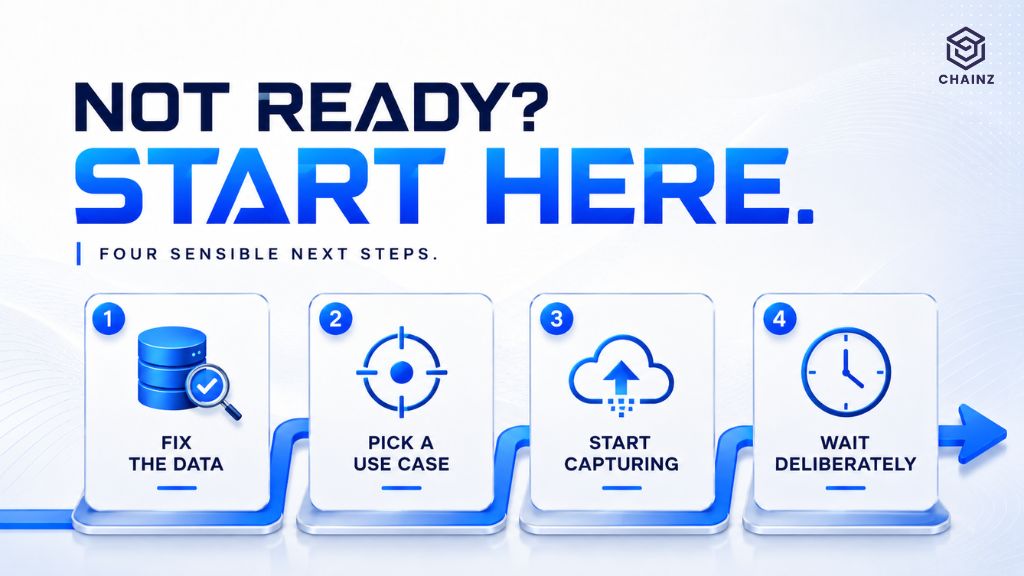
An honest “not ready” is useful information, not a dead end. Four sensible responses:
Fix the data first — if the fix is bounded. Sometimes the problem is a single inconsistent field or one system that needs reconciling. That’s a defined project with a clear end, and it delivers value beyond AI.
Pick a use case your data can support. If prediction is out of reach but your documents are solid, start with document search or extraction. Real value now, and it builds internal confidence.
Start capturing what’s missing. If the signal you need was never recorded, begin recording it. That’s a decision to build AI capability in twelve months rather than never.
Do nothing, deliberately. If the data problem is genuinely large and the AI return is genuinely small, the right answer is to walk away and revisit later. That’s a legitimate outcome.
What you shouldn’t do is proceed anyway and hope the model compensates. It won’t.
Why Vendors Skip This Conversation
It’s worth naming the incentive plainly: telling a prospective client their data isn’t ready usually kills or delays the sale. A quote that excludes data preparation looks cheaper than one that includes it, and the cheaper quote often wins.
That’s why data readiness so often surfaces after a contract is signed, as a change request. Not always dishonestly — sometimes the vendor genuinely didn’t look. But the effect is the same: you pay for the discovery you should have had upfront, at a worse moment.
The defence is simple. Ask any prospective partner what they need to see about your data before they can quote confidently, and how they’d handle finding it isn’t ready. A partner who has thought about it will have a clear answer. One who says “we can start immediately” hasn’t looked. That’s the same signal to watch for when you’re hiring an AI developer generally.
How ChainZ Works With This
We look at data before we quote — not because it’s virtuous, but because it’s the only way to give you a number that survives contact with reality. Where we find gaps, we say so and price the preparation honestly rather than discovering it later. And where the data genuinely can’t support what you’re asking, we’ll tell you that too, and suggest what your data can support instead. A smaller project that works beats an ambitious one that quietly doesn’t.
If you’re building the business case alongside this, our guide on measuring AI ROI covers how to price data preparation into the numbers properly.
Not sure whether your data can carry the project you have in mind?
Tell us the outcome you want and what data you hold, and we’ll give you a straight readiness assessment — what it can support today, what would need fixing, and roughly what that involves. Finding out now costs a conversation. Finding out later costs a project. Check your data readiness with ChainZ →