Search how to build an AI agent and you’ll drown in tutorials aimed at developers – code snippets, framework comparisons, tips on prompt chaining. Useful if you’re an engineer. Useless if you’re a business owner trying to decide whether to build one at all, and how to get it done without wasting money. This guide is the version nobody writes: the steps that actually determine success, explained for the person paying for the project rather than writing the code.
You’ll get the real build process, the honest build-versus-hire decision, and the mistakes that sink AI agent projects before a single line of code matters.
Before You Build: The Decision That Comes First
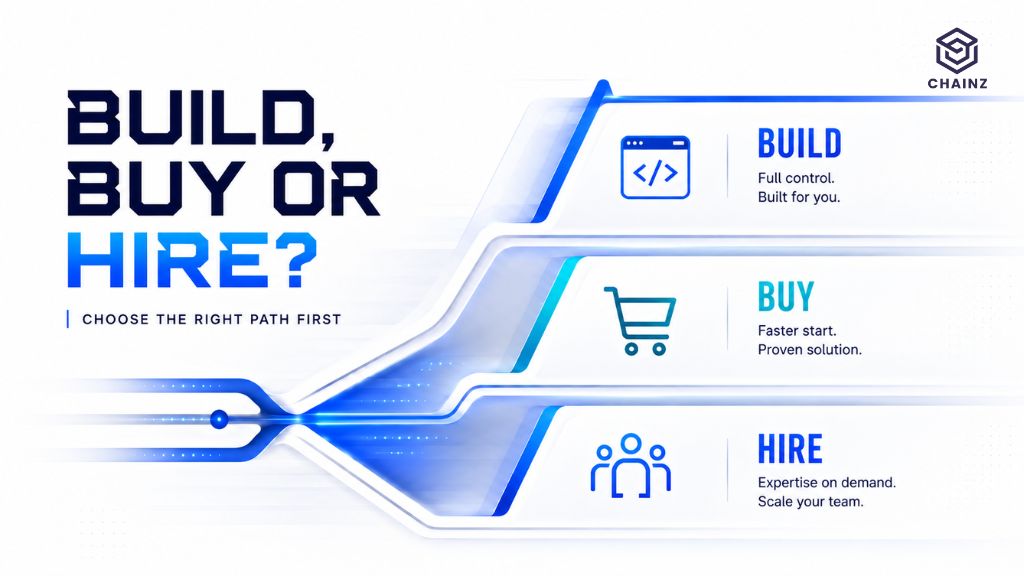
The most important choice isn’t technical – it’s whether to build a custom agent at all. Three paths exist, and picking wrong is the most expensive error available to you.
Buy an off-the-shelf tool when your need is common and standard. If existing software already does what you want for a subscription, building custom to replicate it is money wasted.
Build custom when the task is specific to how your business operates, needs to connect to your systems, or handles data you can’t hand to a third party. This is where custom earns its cost.
Hire versus in-house is the next fork if you go custom. Building an agent properly needs AI engineering skill most businesses don’t have on staff, and hiring it permanently is expensive and slow. For most, a development partner is the practical route – covered in our guide on hiring an AI developer in Australia.
Only once you’ve genuinely settled this does “how to build” become the right question.
How to Build an AI Agent: The Real Steps
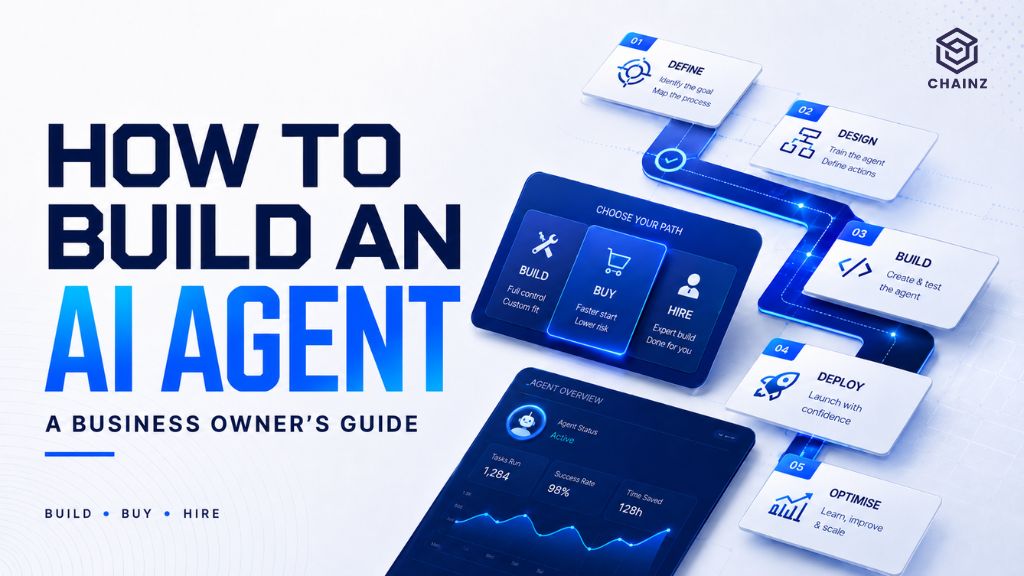
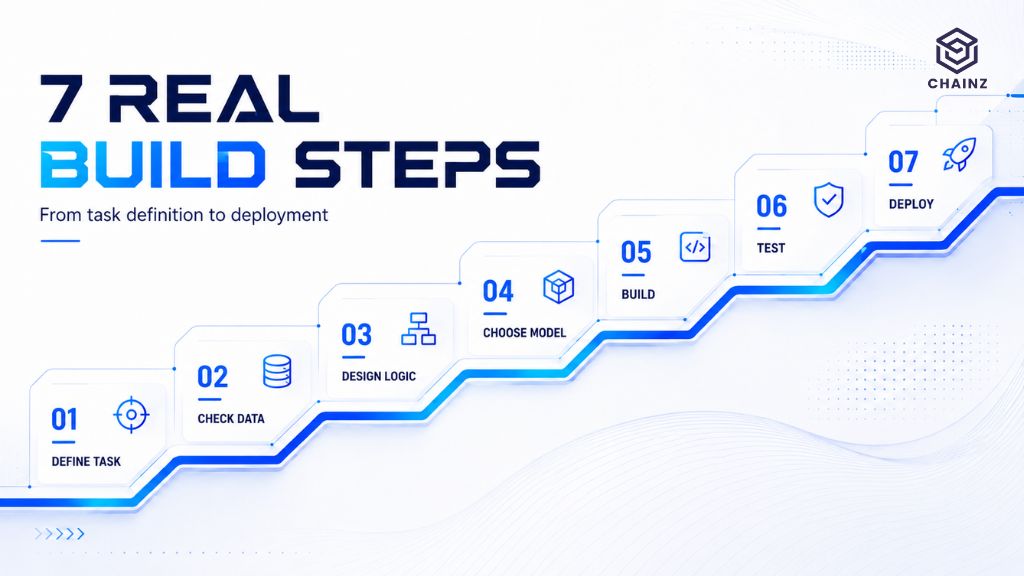
Setting aside the code, every successful AI agent build moves through the same seven stages. The engineering lives in the middle; the success lives at the ends.
1. Define the specific task. Not “an AI agent for support” but “an agent that handles order-status queries by looking up our system and replying.” Precision here determines everything downstream. A vague goal produces a vague, unusable agent.
2. Check the data and systems. The agent needs access to the information and systems it will act on. Is that data accessible, consistent, and current? Can the agent connect to the systems it must read from and write to? This step surfaces most of a project’s hidden cost – assess it honestly using a data readiness check.
3. Design the decision logic. Map what the agent should do in each situation – what it handles, what it escalates, where a human must approve. This is business design, not coding, and you should be deeply involved.
4. Choose the model and approach. GPT-4o, Claude, or an open model; RAG for grounding answers in your data; the right architecture for cost and speed. Your development partner drives this, but the choice should be explained to you in plain terms.
5. Build and integrate. The engineering: constructing the agent, connecting it to your systems, and building the guardrails that keep it safe to act. Integration is usually where the real complexity hides.
6. Test against reality. Run the agent on real, messy cases – not tidy examples. Measure accuracy where it matters, and fix what breaks before anyone relies on it.
7. Deploy, monitor, and refine. Launch narrow, watch performance and running costs, and tune as real usage reveals edge cases. An agent is not “done” at launch; it settles into reliability over the weeks after.
What Actually Makes It Hard (It’s Not the AI)
Business owners assume the difficulty is the AI itself. It rarely is — the language model is the most solved part of the whole project. The hard parts are mundane and decisive:
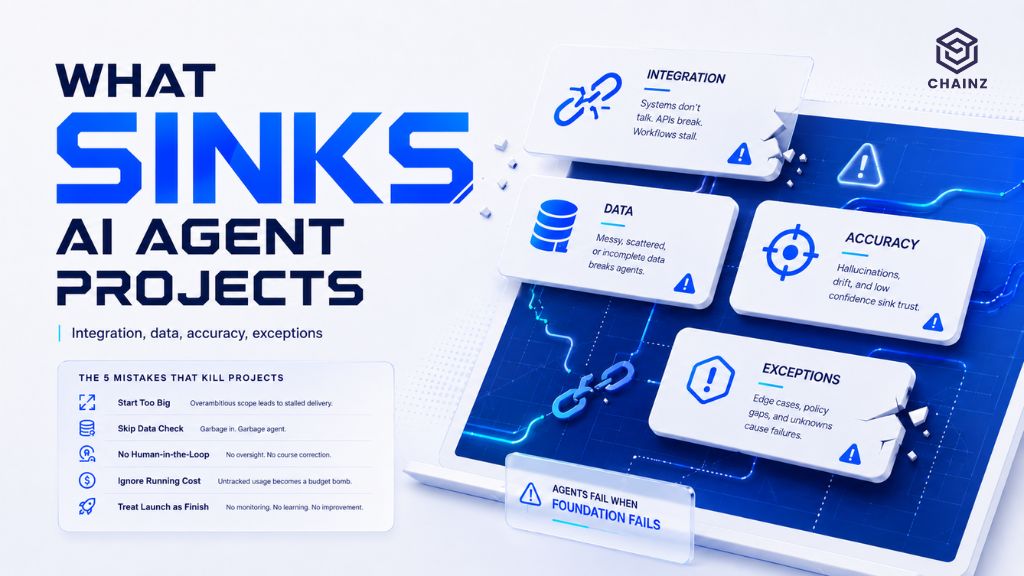
Integration. Connecting the agent to real systems – with their permissions, quirks, legacy interfaces, and security requirements – is where most of the engineering effort and most of the surprises live.
Data quality. An agent acting on inconsistent or incomplete data produces unreliable results no model can fix.
The last 15% of accuracy. Getting an agent to 85% is quick. Getting it reliable enough to trust unsupervised is where the real work concentrates – and where underscoped projects fall apart.
Handling exceptions safely. Deciding what the agent does when it’s unsure – escalate, pause, ask – is the difference between a safe agent and a liability.
Understanding this changes how you evaluate quotes and timelines. A quote that treats the AI as the hard part and integration as an afterthought has the difficulty backwards.
The Mistakes That Sink AI Agent Projects
The failures repeat with remarkable consistency:
- Starting too big. Trying to build an agent that does everything instead of one thing well. Scope tight, prove it, expand.
- Skipping the data check. Discovering mid-build that the data can’t support the goal – the single most common and expensive failure.
- No human-in-the-loop design. An agent that acts without approval paths on consequential decisions is a risk waiting to surface.
- Ignoring running costs. Building without accounting for the per-use model fees that arrive monthly – budget for the full picture, not just the build.
- Treating launch as the finish. The tuning period after launch is where an agent becomes reliable. Projects that end at go-live end at “almost works.”
Most of these are decisions made before any code is written, which is precisely why the business owner’s involvement matters more than the choice of framework.
Build vs Buy vs Hire: A Straight Answer
If you want the decision compressed: buy off-the-shelf if a tool already does the job; build custom with a partner if the task is specific to your business and systems; hire in-house only if AI will be a permanent, central capability you’ll keep building for years. For the large majority of Australian businesses commissioning their first agent, a development partner building a tightly-scoped custom agent is the route that balances cost, quality, and speed – without the overhead of a permanent hire or the compromise of a generic tool.
The full cost picture for that path is in our AI agent development cost guide.
How ChainZ Builds AI Agents
We handle the seven stages end to end, but we start by pressure-testing the two things that decide success before code: is the task defined precisely enough, and can your data and systems actually support it? We build tightly scoped agents that connect to the systems you already use, design the human approval paths deliberately, and architect for the tuning that comes after launch rather than treating go-live as the finish line.
And if the honest answer is that an off-the-shelf tool would serve you better, we say so. You can see how we scope and build on our AI agent development services page.
Weighing up whether to build, buy, or hire?
That’s the decision worth getting right before anything else. Tell us the task you have in mind and we’ll give you a straight recommendation — including when the honest answer is an off-the-shelf tool or a different approach entirely. No code required to have the conversation. Talk it through with ChainZ →