
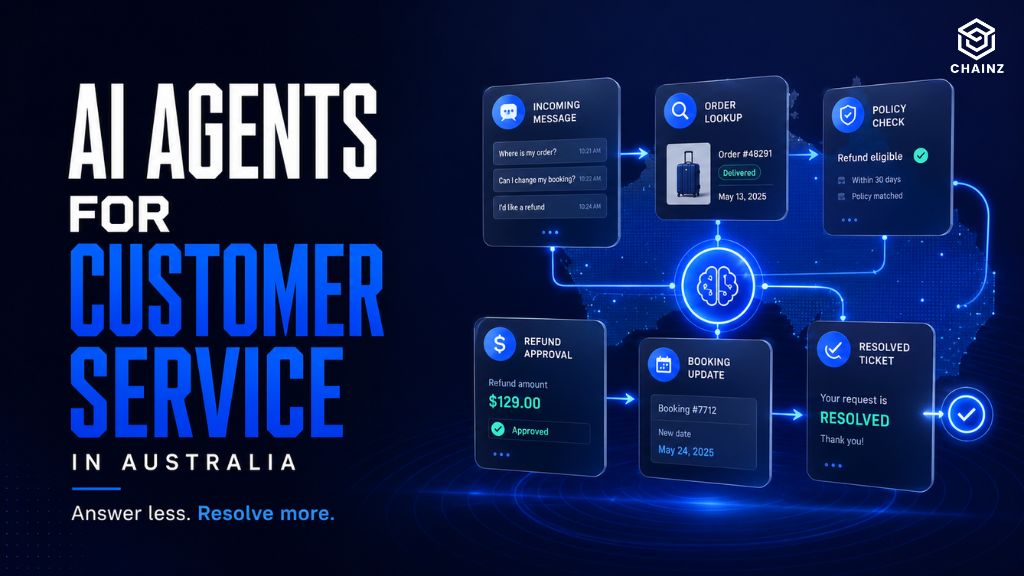
An AI agent for customer service doesn’t just answer questions – it resolves them. Where a chatbot replies with information and hopes that’s enough, an agent looks up the customer’s order, checks the policy, processes the refund, updates the record, and confirms it done. That’s the difference between deflecting a query and actually closing it, and it’s why customer service is the single most common place Australian businesses deploy their first AI agent.
It’s also the place where getting it wrong is most visible. This guide covers what an AI agent for customer service actually handles, where humans remain essential, and how to deploy one that customers trust rather than resent.
Answering vs Resolving: The Distinction That Matters
Most “AI customer service” you’ve encountered is a chatbot – it matches your question to an FAQ and returns text. Useful for “what are your opening hours,” useless the moment you need something done.
An AI agent for customer service operates differently because it connects to your systems and acts within them. Ask it to change your delivery address and it doesn’t tell you how – it does it, updates the order, and confirms. Ask about a refund and it checks eligibility against the actual policy and the actual transaction, then processes it or explains precisely why not. The customer’s problem is solved in the conversation, not handed to a queue.
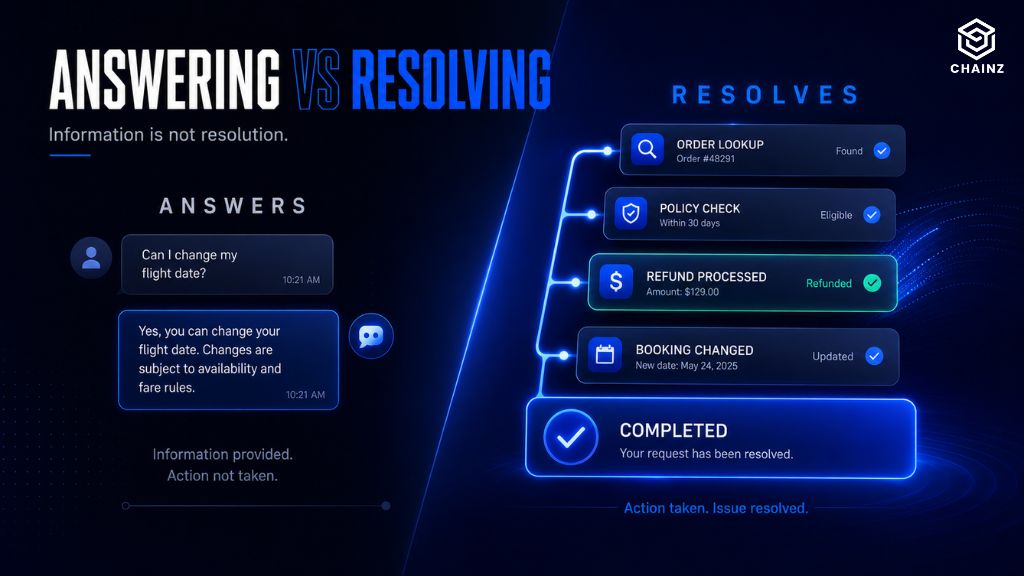
That shift from answering to resolving is the entire value proposition, and it’s worth being clear it depends on integration. An agent disconnected from your systems is just a chatbot with better manners.
What an AI Agent Handles Well in Customer Service
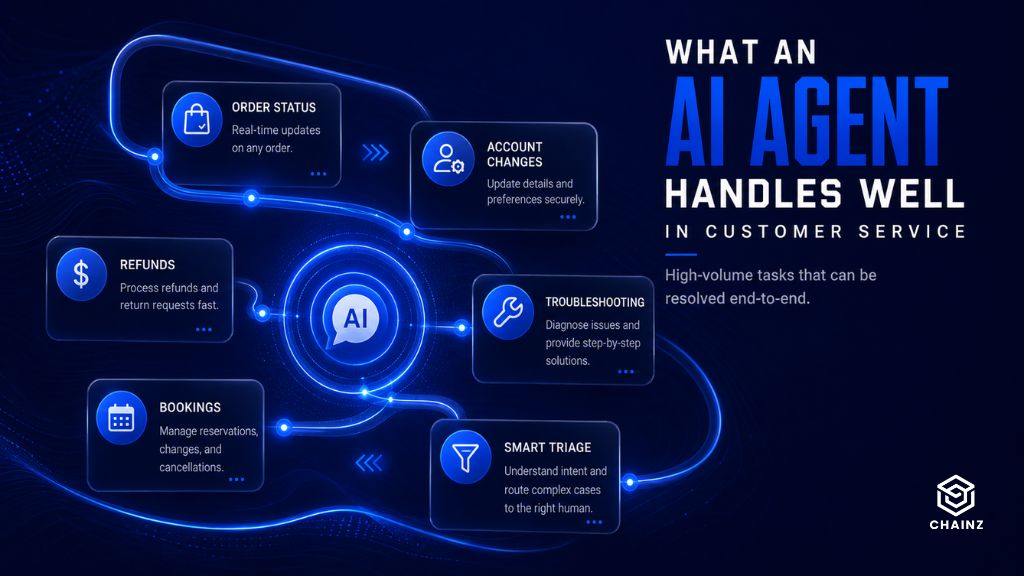
The tasks where an agent reliably delivers:
- Order status and tracking – pulling live information and answering follow-ups in context
- Account changes – updating addresses, preferences, and details directly in your systems
- Returns and refunds – checking eligibility against policy and processing within defined limits
- Routine troubleshooting – walking through known resolution steps and confirming the fix
- Booking and rescheduling – checking availability and updating your system live
- Triage and routing – assessing what it can’t resolve and passing it to the right human with a full summary attached
The pattern: high-volume, well-defined interactions that follow knowable logic but require action across systems. These are the queries currently consuming most of your team’s time – and the ones customers most resent waiting in a queue for.
Where Humans Stay Essential – and Should
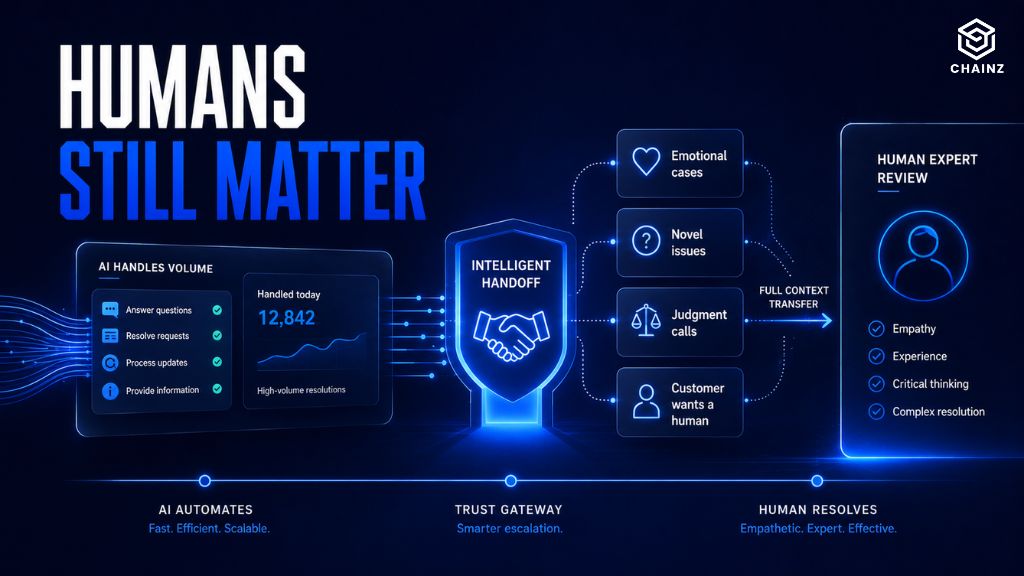
Deploying an AI agent well means being honest about its limits. Some interactions should always reach a person, and designing for that is a feature, not a failure:
- Emotional or high-stakes situations – a distressed customer, a complaint, a sensitive account matter needs human empathy, not efficient processing
- Genuinely novel problems – anything outside known patterns should escalate, not be improvised
- High-value judgment calls – a goodwill exception, a retention decision, an unusual request with financial weight
- Anything the customer wants a human for – the option to reach a person, easily, is non-negotiable
The best AI customer service deployments aren’t the ones that eliminate humans. They’re the ones that clear the repetitive volume so human agents can give their full attention to the interactions that actually need it. That reframing – AI handles volume, humans handle what matters – is what separates a deployment customers appreciate from one they fight against.
The Fastest Way to Lose Customer Trust
Three mistakes turn a customer service agent from asset to liability, and they’re worth naming because they’re common:
Hiding that it’s an AI. Customers can tell, and pretending otherwise breaks trust the moment they realise. Be upfront – a capable agent doesn’t need to pretend to be human to be useful.
Trapping people with no way out. The single most infuriating experience in customer service is being stuck with a bot that can’t help and won’t hand over. An easy, obvious route to a human isn’t a fallback – it’s a requirement.
Letting it guess. An agent that invents an answer when unsure is worse than one that says “I’ll pass this to someone who can help.” In customer service, a confident wrong answer about a refund or policy creates a real problem. This is where accuracy engineering matters – the same reason a RAG chatbot that answers only from your verified content beats one guessing from general training.
Measuring Whether It’s Working
A customer service agent should be judged on resolution, not deflection. The metrics that matter:
Resolution rate – the share of interactions the agent fully closes without a human. This is the real number; “contained” or “deflected” queries that leave the customer unsatisfied don’t count.
Escalation quality – when the agent hands over, does the human receive full context, or does the customer have to repeat everything? Poor handoffs erase the time the agent saved.
Customer satisfaction on agent-handled interactions – measured specifically, not blended with human interactions. If satisfaction drops when the agent handles a query, something’s wrong regardless of how much volume it cleared.
Cost per resolution – including the agent’s running costs, compared honestly against the human baseline. This is where the ROI case lives, and it’s worth calculating properly using an ROI framework rather than assuming.
Deployment: Start Narrow, Then Widen
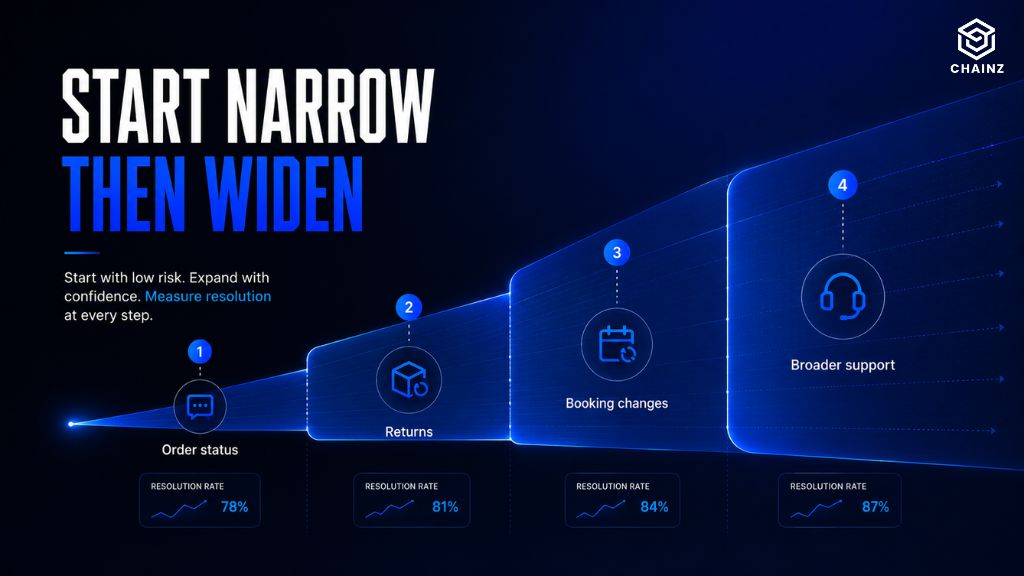
The businesses that succeed with customer service agents rarely switch everything over at once. The reliable path is to start with a single, high-volume, low-risk query type – order status is a common first choice – and get it genuinely excellent before adding the next. This limits the blast radius if something’s off, builds internal confidence, and lets you measure the impact of each addition cleanly. Widening from a proven base beats launching broad and firefighting.
How ChainZ Builds Customer Service Agents
We build customer service agents that resolve rather than deflect – which means connecting them properly to the systems where the resolution actually happens, not bolting a chatbot onto your homepage. We design the human handoff as carefully as the automation, because a bad escalation undoes the good work. And we build in honest “I’ll pass this on” behaviour over guessing, because in customer service, trust is the whole game.
We work on real AEST overlap, so when you need a change made or an issue looked at, it happens the same business day. You can see how we approach this on our AI agent development services page.
Know which queries are eating your support team’s day?
Tell us the top three questions your customers ask most, and we’ll show you which an AI agent could resolve end-to-end, which should stay with your team, and what it would connect to. A clear picture before you commit to anything. Talk to ChainZ about customer service AI →