Most advice about AI for small business in Australia is written for companies with a data team and a six-figure budget. That isn’t the reality for the overwhelming majority of Australian SMEs, who have a handful of staff already stretched thin, no in-house technical resource, and a healthy scepticism about spending money on something they can’t see working yet.
The good news is that the SME position is genuinely advantageous in one respect: you can start small, prove value on something real, and expand from there — without the committee approvals and legacy system tangle that slow larger organisations down. This guide covers where to start, what to avoid, and how to know when you’re ready.
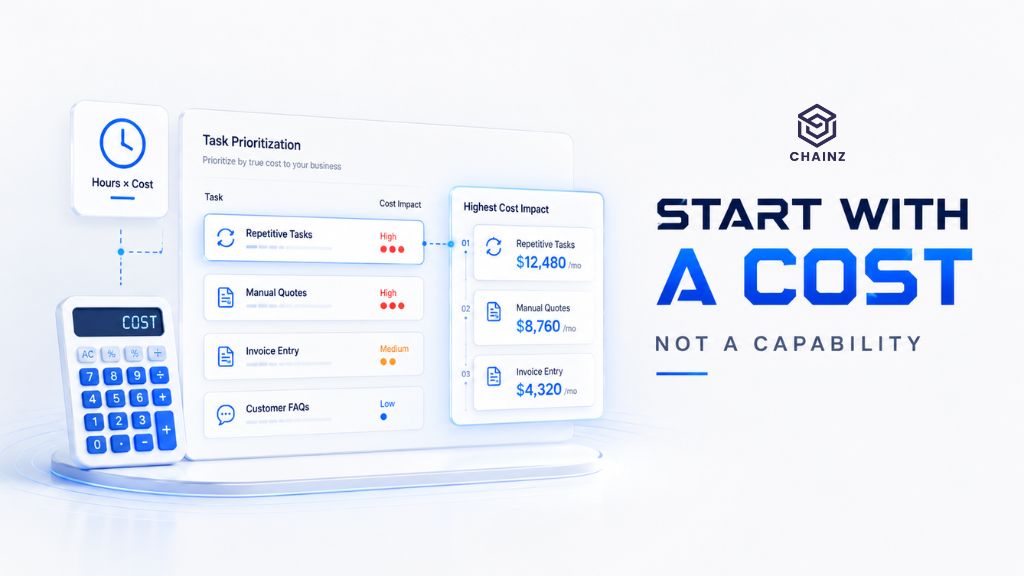
Start With a Cost, Not a Capability
The most common way an SME wastes money on AI is starting from the technology. Someone reads about what AI can do, gets enthusiastic, and asks “how could we use this?” That question almost always produces an interesting project with no clear return.
Reverse it. Ask instead: what is the most expensive repetitive task in this business right now? Not the most annoying — the most expensive, measured in hours multiplied by what those hours cost you. That question produces a shortlist grounded in money, and the answers are usually unglamorous: someone re-typing information between systems, someone answering the same twelve customer questions all day, someone manually processing invoices or quotes.
Unglamorous is exactly right for a first project. The boring tasks are where the reliable savings live.
Where AI Actually Pays Off for Australian SMEs
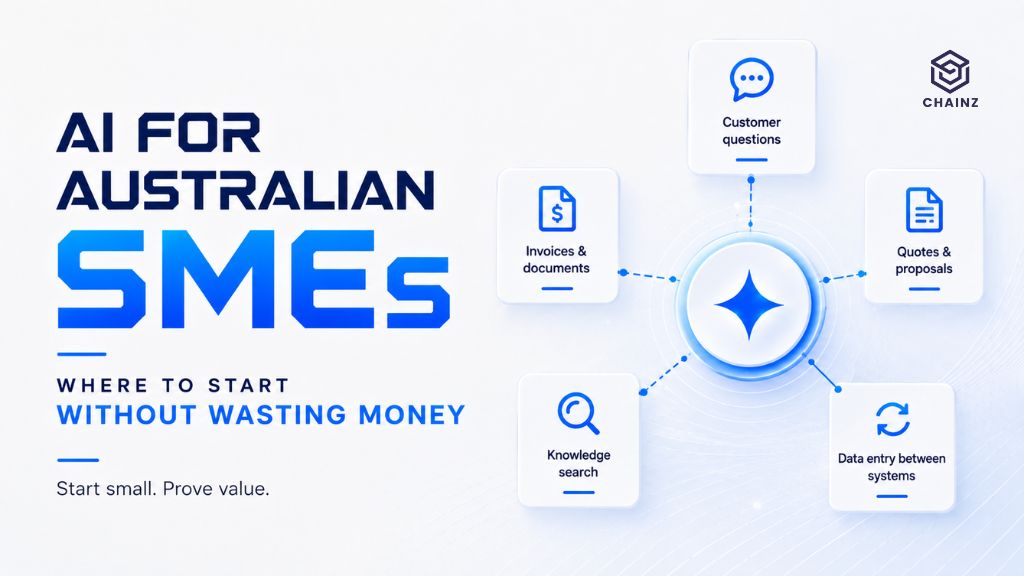
Across small businesses, the same handful of use cases deliver returns consistently:
| Use case | Typical situation | Why it works for SMEs |
|---|---|---|
| Customer question handling | Same enquiries answered repeatedly | High volume, well-defined, fast to build |
| Document and invoice processing | Manual data entry from PDFs or emails | Removes a genuinely costly task; proven pattern |
| Quote and proposal drafting | Staff rewriting similar documents | Big time saving, low risk if reviewed |
| Internal knowledge search | “Where’s that document?” asked daily | Cheap to build, immediately useful |
| Data entry between systems | Re-keying between tools that don’t talk | Often the highest-return first project |
What these share: they’re repetitive, high-volume, language-based, and the cost of an occasional error is manageable because a human is still reviewing output. That combination is the sweet spot for a first AI project.
What SMEs Should Avoid First
Equally useful is knowing what not to start with:
Predictive modelling. Forecasting demand or predicting customer churn sounds valuable, but it demands substantial clean historical data that most SMEs don’t have. It’s the most likely first project to fail.
Anything customer-facing without review. An AI that emails customers or makes commitments without a human checking is a large risk for a small business. Start where a person still approves the output.
Building what you could buy. If an existing tool solves your problem for a monthly subscription, use it. Custom development earns its cost when the task is specific to how your business works or needs to connect to your systems.
Everything at once. One project, proven, then the next. Momentum from a small win funds and justifies the bigger ones.
The Realistic Budget for a First Project
An SME’s first AI project doesn’t need to be large. A focused build addressing one specific process typically sits well below the figures quoted for enterprise AI, and the discipline of keeping it small is a feature rather than a limitation — it forces clarity about what you’re actually solving.
Two things to budget for beyond the build itself. First, ongoing running costs: AI systems that use language models carry a per-use fee, usually modest at SME volumes but never zero. Second, your own time: someone in your business needs to be available during the build to answer questions about how the process really works. That person’s involvement is the difference between a system that fits your business and one that fits a generic template.
If you want to put real figures around it before committing, our guide on measuring AI ROI walks through the calculation, and AI agent development costs in Australia covers build and running costs in detail.
Off-the-Shelf First: The Honest Advice
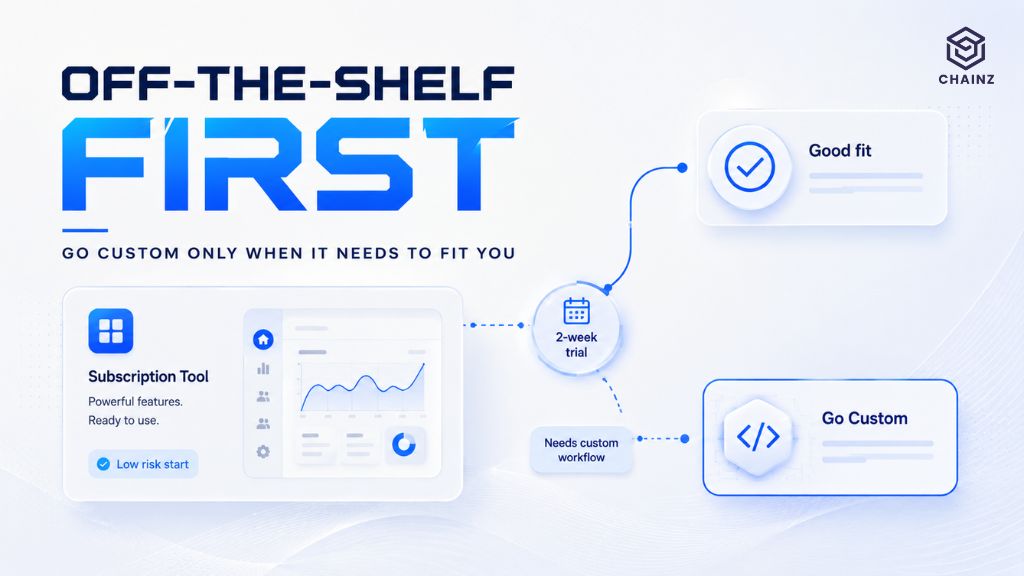
Before commissioning anything custom, spend a fortnight seriously testing whether existing tools solve your problem. Many SME needs are genuinely met by subscription software, and paying for a custom build to replicate that is money badly spent.
The threshold for going custom is reasonably clear. Build custom when the task is specific to how your business operates rather than a generic pattern, when it needs to connect to systems you already use, when the data involved can’t be handed to a third-party tool, or when you’ve tried the off-the-shelf option and hit a wall you can name precisely.
That last point matters most. “We tried Tool X and it couldn’t handle our supplier formats” is a strong basis for a custom build. “We think custom would be better” isn’t.
Privacy and Compliance: The Part SMEs Skip
Australian small businesses have historically had a degree of exemption from privacy obligations, and many assume this means compliance isn’t their concern. That assumption is becoming risky.
Australia’s privacy framework is tightening around AI specifically, with new transparency obligations around automated decision-making coming into force. Separately, the long-standing small business exemption has been under active review as part of the broader reforms. The direction of travel is clear even where the detail is still settling.
The practical response for an SME isn’t alarm — it’s building sensibly from the start. Know where your data goes when you use an AI tool, particularly whether it leaves Australia. Avoid putting sensitive customer information into consumer AI tools without checking their terms. And if AI is influencing decisions that affect individuals, keep a record of how those decisions are made. Building these habits into a first project costs almost nothing; retrofitting them later is expensive.
Signs You’re Ready — and Signs You’re Not
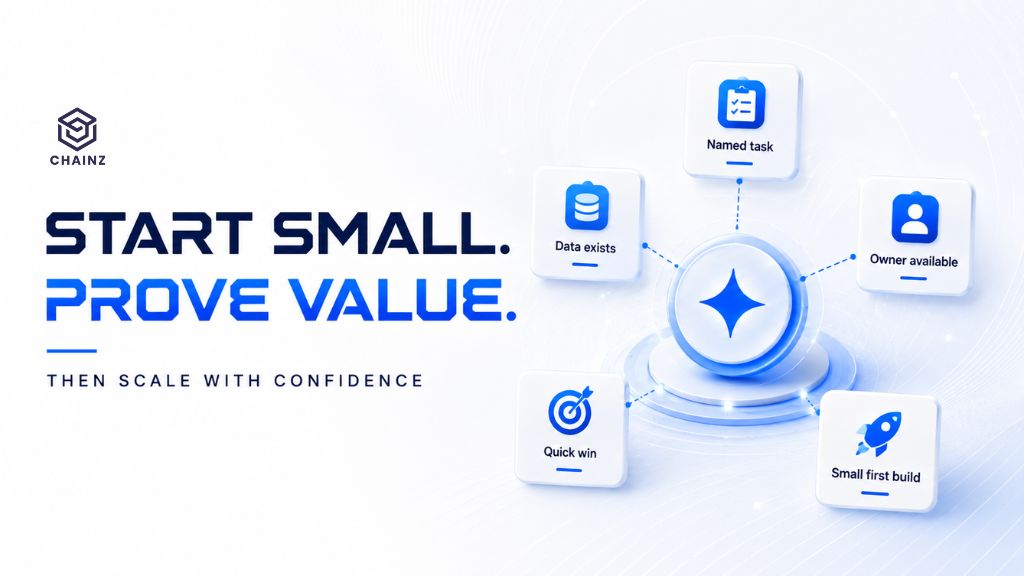
You’re ready when:
- You can name a specific, repetitive task and roughly what it costs you annually
- Someone in the business can commit time to the project
- You’ve checked whether an existing tool already solves it
- You have the information the AI would need, in a form someone could actually use
You’re not ready when:
- The goal is “we should be using AI” rather than a named problem
- Nobody has time to be involved
- The data you’d need isn’t recorded anywhere
- You need the first project to transform the business rather than prove a point
That last one deserves emphasis. A first AI project’s job is to produce a genuine, measurable win on something modest — building the internal confidence and evidence to justify the next one. Expecting it to be transformative is how good starting points get rejected for being unambitious.
How ChainZ Works With Smaller Businesses
We’re comfortable starting small, and we don’t inflate a first project to make it worth doing. If a fortnight with an off-the-shelf tool would solve your problem, we’ll tell you that — it costs us a project and saves you a budget, and it’s how you end up trusting the advice when the answer is different.
When a custom build genuinely fits, we scope it tightly, price it upfront, and build it to be extended rather than replaced when the next need appears. And we work on real AEST overlap, so questions get answered the same day rather than sitting in an inbox overnight, which matters more for a small team than it does for an enterprise.
Not sure whether your business is at the right stage for this?
Tell us the task that’s eating the most time each week and we’ll tell you honestly whether AI is worth it — including whether an off-the-shelf tool would do the job for a fraction of the cost. Plenty of these conversations end with us recommending something we don’t sell. Ask ChainZ about your first project →