
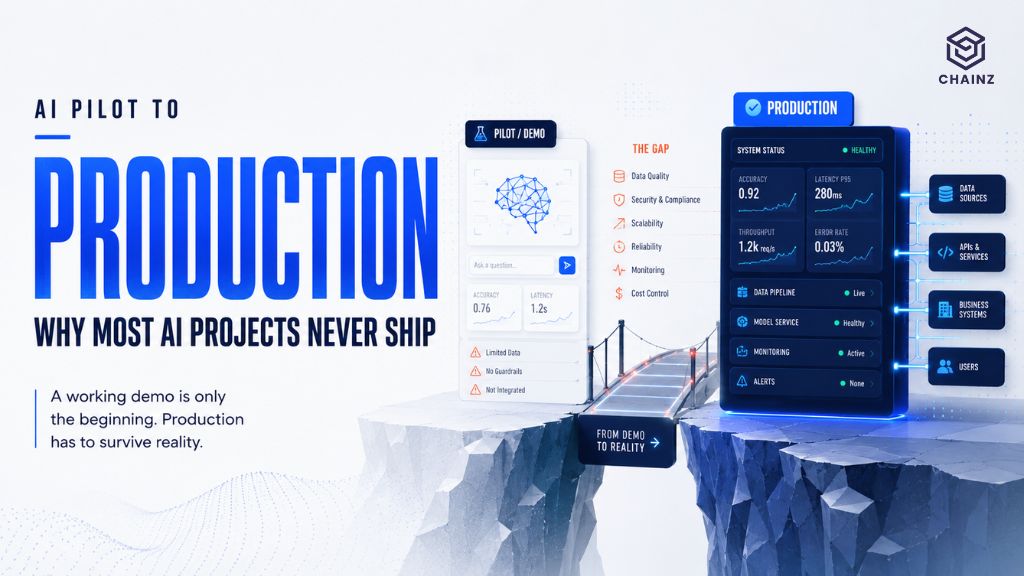
The demo works. Everyone in the room is impressed. Twelve months later, it’s still a demo – and nobody can quite explain what happened. The journey from AI pilot to production is where the majority of corporate AI investment quietly disappears, and the reason is rarely the technology. Pilots are built to prove a concept. Production systems have to survive reality. Those are different engineering problems, and most pilots were never designed to become the second one.
This guide explains what actually separates the two, why so many promising pilots stall, and how to design one that’s built to ship from the start.
Why the Gap Exists
A pilot succeeds by demonstrating that something is possible. It runs on curated data, in controlled conditions, with a knowledgeable person driving it and forgiving the rough edges. That’s not cheating – it’s the correct scope for proving a concept.
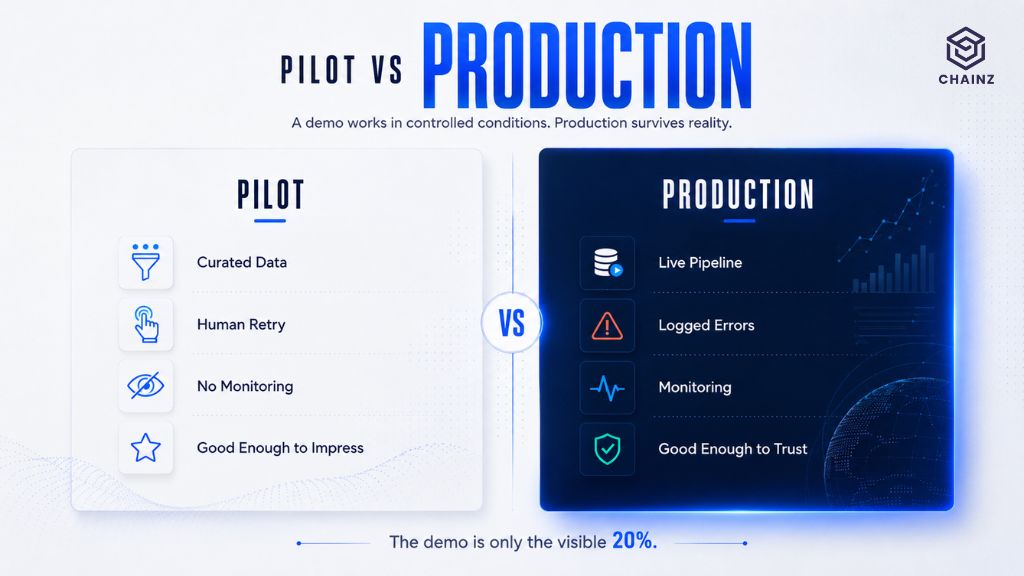
Production succeeds by being dependable. It runs on whatever real users throw at it, at real volume, without supervision, integrated into systems that break, and it has to be right often enough that people trust it. The functional demo is perhaps 20% of that work. The remaining 80% – error handling, integration, monitoring, security, edge cases, and the accuracy work that turns “impressive” into “reliable” – is invisible during the pilot and rarely budgeted for.
The gap isn’t a skill problem. It’s an expectation problem, created the moment a working demo is mistaken for a nearly-finished product.
The Six Reasons Pilots Stall
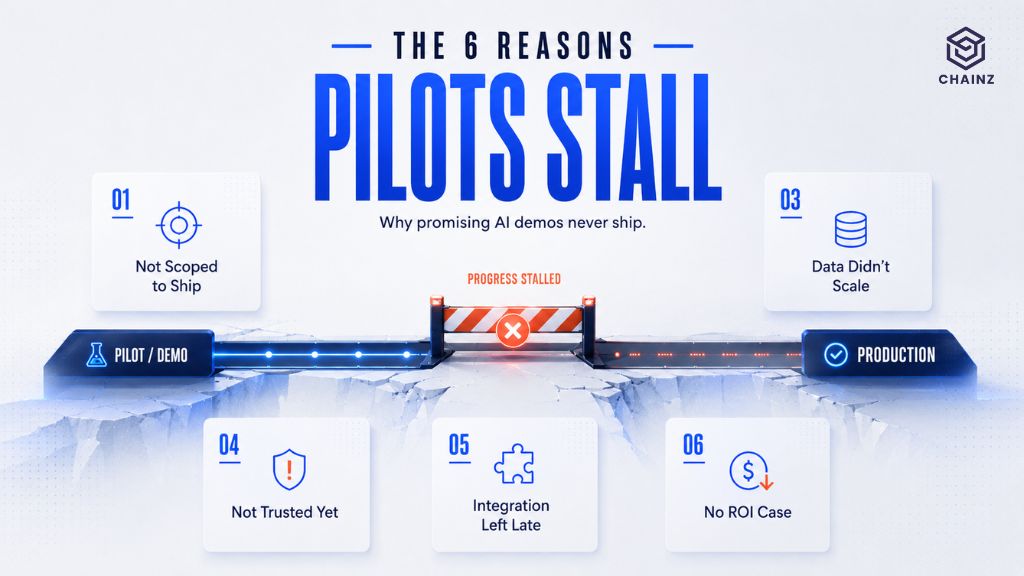
1. It was never scoped to ship. Built as an experiment on a laptop with sample data, with no plan for where it would live, who would maintain it, or how it would connect to anything.
2. Nobody owns it. The pilot had a champion. Production needs an owner – someone accountable for it working next quarter. Without that, it drifts.
3. The data didn’t scale. The pilot ran on a clean sample someone prepared by hand. Real data is messier, and nobody costed the pipeline to handle it continuously.
4. Accuracy was good enough to impress, not to trust. 85% accuracy makes a compelling demo and an unusable production system if the remaining 15% carries real consequences. Closing that gap is often harder than everything before it.
5. Integration was left until last. Connecting to live systems is where hidden complexity lives: permissions, legacy interfaces, data formats, security review. Discovering this after the pilot means re-architecting.
6. No ROI case was ever built. When it’s time to fund production, someone asks what it’s worth – and nobody can answer with numbers. The project dies at the budget meeting rather than the technical one. This is why building the ROI case belongs at the start, not after the pilot succeeds.
What Production Actually Requires (That a Pilot Doesn’t)
The honest inventory of what gets added between demo and dependable:
| Pilot | Production | |
|---|---|---|
| Data | Curated sample, prepared once | Live pipeline, handles mess continuously |
| Accuracy | Good enough to impress | Good enough to trust unsupervised |
| Errors | A human notices and retries | Detected, handled, logged, recovered |
| Integration | Often none | Live systems, permissions, security review |
| Monitoring | None | Performance, cost, accuracy drift, alerts |
| Security | Informal | Access control, encryption, audit trail |
| Cost control | Irrelevant at test volume | Model fees at real volume, actively managed |
| Ownership | Whoever built it | A named owner with a maintenance budget |
Reading that table is the fastest way to understand why “it already works” is a misleading statement about a pilot. It works in the conditions it was built for.
Design the Pilot to Ship: Four Rules
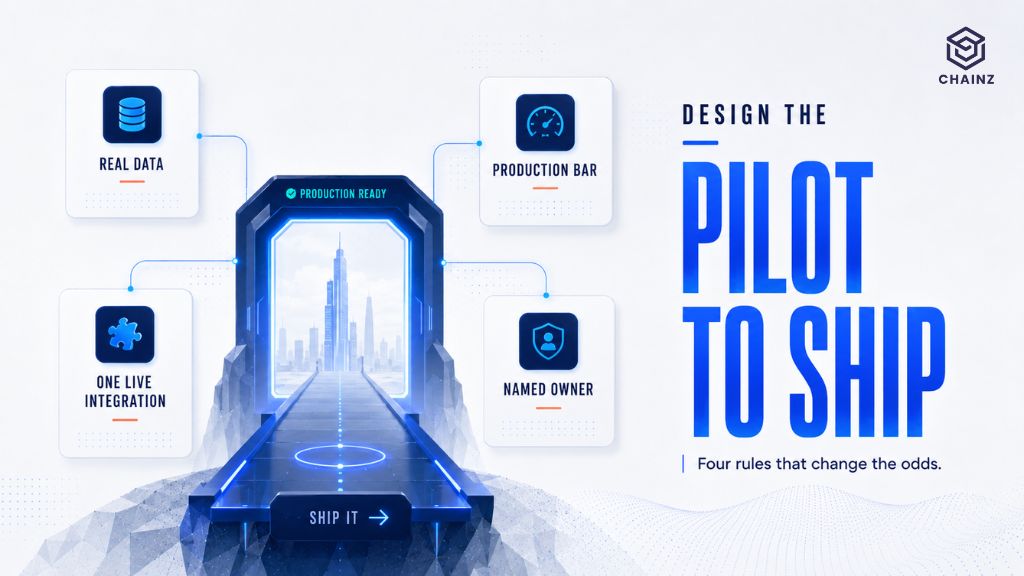
The productive response isn’t to skip pilots – it’s to build them differently. Four rules change the odds substantially.
Rule 1: Pilot on real data, not a clean sample. The single highest-value change. Use messy, representative production data from day one. It makes the pilot less impressive and vastly more informative – you learn what will actually break before you’ve committed.
Rule 2: Define the production bar before you start. Agree the accuracy threshold, volume, and response time that would make this worth deploying – in writing, before building. Without a defined bar, “is it good enough?” becomes a matter of opinion and the project stalls in debate.
Rule 3: Include one real integration. Not all of them – one. Connecting to a single live system during the pilot surfaces the permission, security, and format problems that otherwise ambush you later.
Rule 4: Name the production owner on day one. Before building, identify who will own this in production and what their maintenance budget is. If nobody will own it, that’s valuable information – you’ve just saved the pilot cost.
The Question That Kills More Pilots Than Any Technical Problem
Ask it before you build, not after:
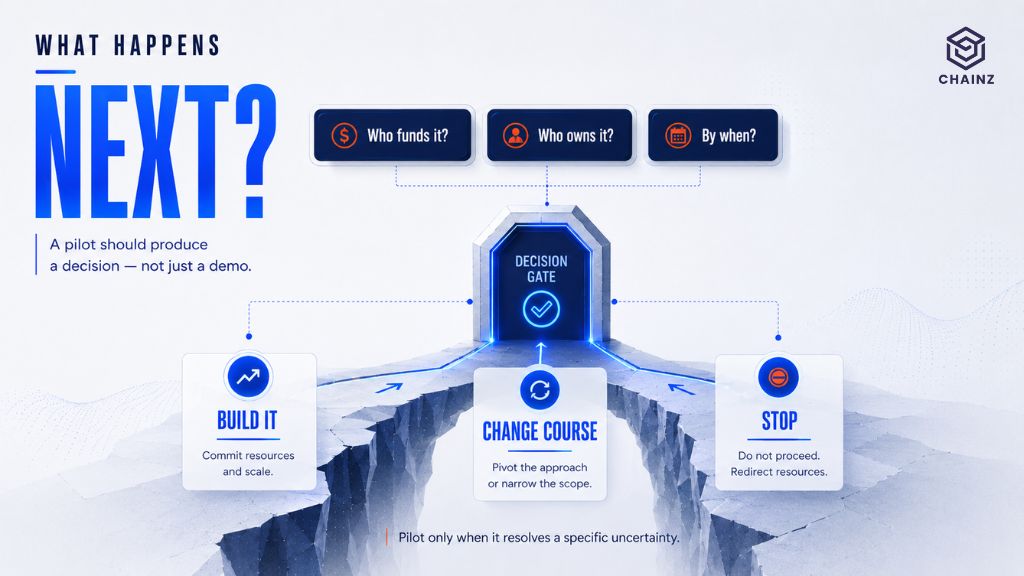
If this pilot succeeds, what exactly happens next – who funds it, who owns it, and by when?
If nobody in the room can answer, the pilot is already at high risk regardless of how well it performs. A pilot without a defined path to production isn’t a step toward deployment; it’s an expensive way to confirm something was technically possible.
This question also usefully reframes what a pilot is for. A successful pilot shouldn’t produce a demo – it should produce a decision, backed by evidence: build it properly, change the approach, or stop. All three are legitimate outcomes. Only ambiguity is a failure.
When You Should Skip the Pilot Entirely
Not every project needs one, and running a pilot by reflex wastes both time and budget.
Skip it when the use case is well-established and the pattern is proven – document extraction, retrieval-based Q&A over your own content, and similar applications are no longer experimental. Piloting them mostly proves what’s already known, while adding months to your timeline.
Pilot when you’re genuinely uncertain: when accuracy requirements are demanding and unproven for your data, when the use case is unusual, or when your data quality is unknown. In other words, pilot to resolve a specific uncertainty you can name – not to reassure yourself in general.
If you can’t name the uncertainty the pilot exists to resolve, you probably don’t need the pilot. Build the smallest real version instead, in the same way you’d approach an MVP for a software product.
How ChainZ Approaches This
We build pilots that are designed to become production systems – on real data, with the production bar agreed upfront, and at least one live integration in scope. When a pilot succeeds with us, the next step is extending what exists rather than starting again, because it was architected for that from the beginning.
And when the honest outcome of a pilot is “this shouldn’t proceed,” we say so with the evidence attached. A clear no after four weeks is a far better result than an ambiguous maybe that consumes a year. You can see how we structure this work across our AI development services.