

For Australian businesses, offshore software development promises an obvious win: the same software for a fraction of the local price. Sometimes that’s exactly what you get. Other times, the cheap hourly rate hides a bill that arrives later – in miscommunication, rework, and months lost to a 24-hour feedback loop. The difference between the two outcomes usually comes down to one factor most people overlook when they focus on cost alone.
This guide lays out the real trade-offs between offshore, local, and timezone-aligned development — what each actually costs, where the hidden costs hide, and how to choose based on what you’re building rather than the hourly rate alone.
The Three Options, Honestly Compared
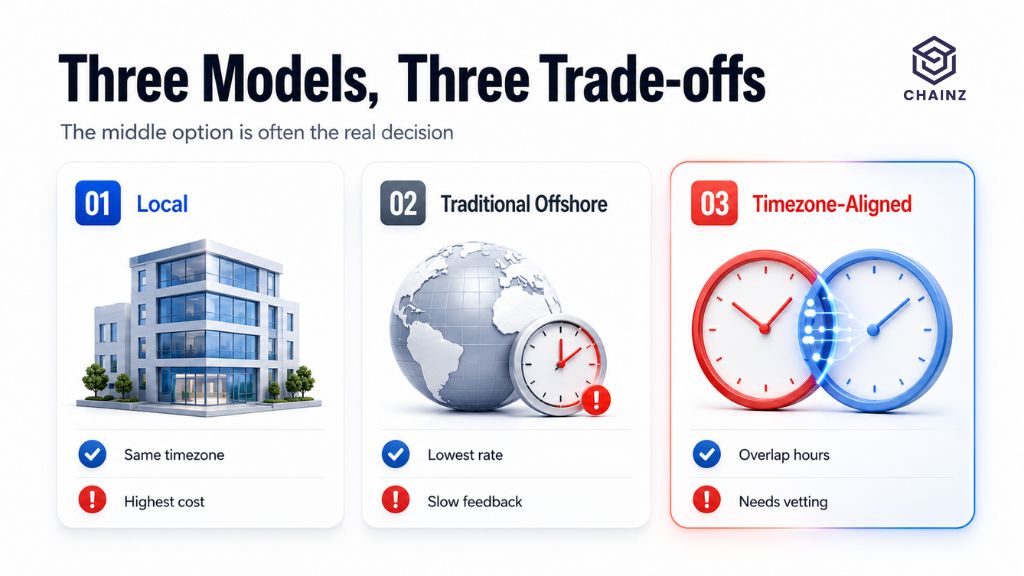
Most decisions get framed as “cheap offshore versus expensive local.” The reality has three options, not two:
| Option | Typical rate | The real advantage | The real risk |
|---|---|---|---|
| Local (onshore) | Highest | Same timezone, same culture, easy to meet | Cost; a senior AU developer can command $170K+/year |
| Traditional offshore (far timezone) | Lowest | Lowest hourly rate | Little or no work-hour overlap; slow feedback; rework |
| Timezone-aligned (e.g. SEA with AEST overlap) | Middle | Quality at a commercial rate, real-time collaboration | Requires vetting for genuine overlap, not just a cheap rate |
The mistake is treating this as a straight line from cheap to expensive. It isn’t. The middle option often delivers the best total outcome — which brings us to the factor that actually decides success.
The Real Variable Isn’t Distance – It’s Timezone Overlap
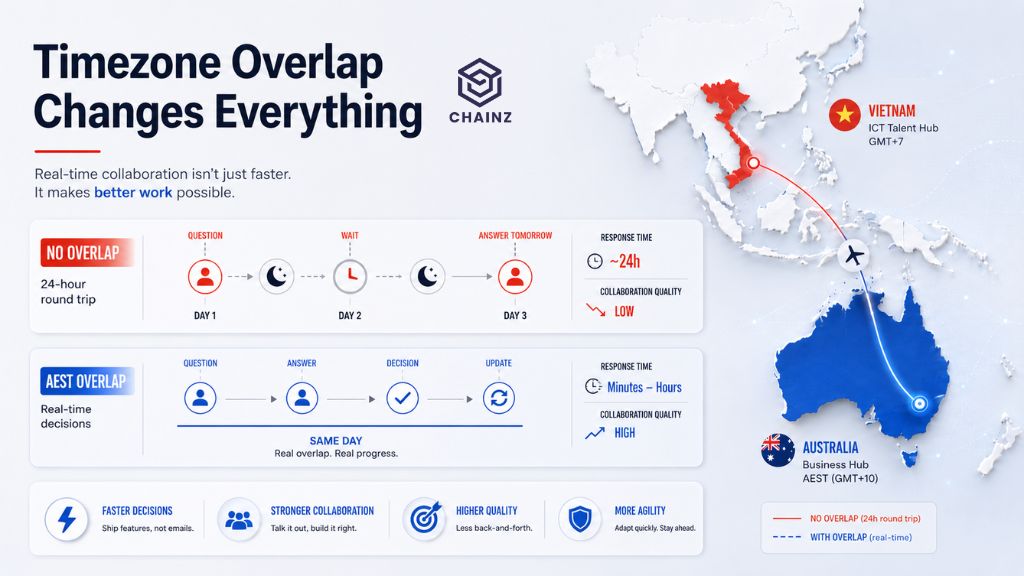
Here’s the reframe that changes the whole decision: what damages offshore projects is rarely the distance or the accent. It’s the lack of overlapping work hours.
When your team and your developers share no working hours, every question becomes a 24-hour round trip. You ask something at 5pm; you get an answer tomorrow afternoon; your follow-up waits another full day. A conversation that takes ten minutes in real time stretches across three days. Multiply that across a project and you get the classic offshore horror story – not because the developers were bad, but because the feedback loop was broken.
A team in Vietnam or Southeast Asia working on genuine AEST overlap sidesteps this entirely. You get the lower cost structure of offshore and the real-time collaboration of local. That combination – not the rock-bottom hourly rate – is what actually makes offshore software development work for Australian businesses.
The Hidden Cost Math: Why Cheapest Rarely Means Cheapest
A $25/hour developer looks like a bargain next to a $150/hour local one. But the hourly rate is only the visible cost. The real total includes:
- Rework from requirements lost in translation or across the time gap
- Delays as decisions wait on slow, asynchronous communication
- Management overhead – someone on your side spending hours bridging the gap
- Quality issues surfacing late, when they’re most expensive to fix
A cheaper rate that produces work needing 40% rework isn’t cheaper. The metric that matters is cost per delivered, working outcome – not cost per hour. This is exactly why timezone-aligned teams have become the pragmatic default: they protect the rate advantage without paying it back in rework.
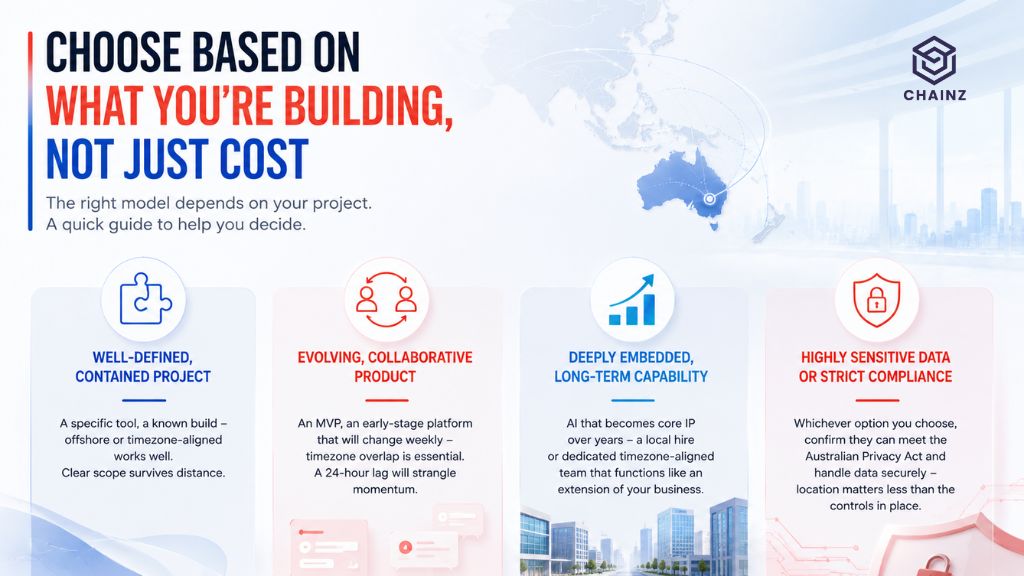
Choose Based on What You’re Building, Not Just Cost
The right model depends on the project. A quick guide:
- Well-defined, contained project (a specific tool, a known build): offshore or timezone-aligned works well – clear scope survives distance.
- Evolving, collaborative product (an MVP, an early-stage platform that will change weekly): timezone overlap becomes essential. You’ll be making decisions constantly, and a 24-hour lag will strangle momentum.
- Deeply embedded, long-term capability (AI that becomes core IP over years): a local hire or a dedicated timezone-aligned team that functions like an extension of your business.
- Highly sensitive data or strict compliance: whichever option you choose, confirm they can meet the Australian Privacy Act and handle data securely – location matters less than the controls in place.
Don’t Skip This: IP Ownership and Vetting
Two things Australian businesses forget to check when going offshore:
Code ownership. Confirm in writing that you own the code, the credentials, and the infrastructure at the end – not the vendor. A good partner hands over everything with no lock-in. If ownership is vague in the contract, walk away.
Real vetting. Ask for production systems they’ve shipped, not demos. Ask who actually does the work. Ask how they handle the overlap in practice – a team claiming “we work with Australian clients” should be able to describe exactly how many overlap hours you’ll get each day. Vague answers here are a red flag.
Where ChainZ Sits
We’re based in Hanoi and built to work with Australian businesses – which means genuine AEST overlap every day, not a token hour. You get the cost structure that makes offshore attractive and the real-time collaboration that makes local work, without choosing between them. Senior engineers, full code ownership handed to you at the end, and weekly demos so progress is never a mystery.
If you’re weighing this against a local hire, our guide on how to hire an AI developer in Australia breaks down the cost comparison, and our custom software development cost guide covers what a full build should run.
Curious whether timezone-aligned development actually delivers what it promises?
The easiest way to find out is a small, real project – not a sales call. Tell us what you’re working on and we’ll show you how the daily overlap works in practice, and what it would take to deliver. See the difference before you commit to anything bigger. Talk to ChainZ →